Small business management / 2026
Giro, the management system small businesses run from WhatsApp
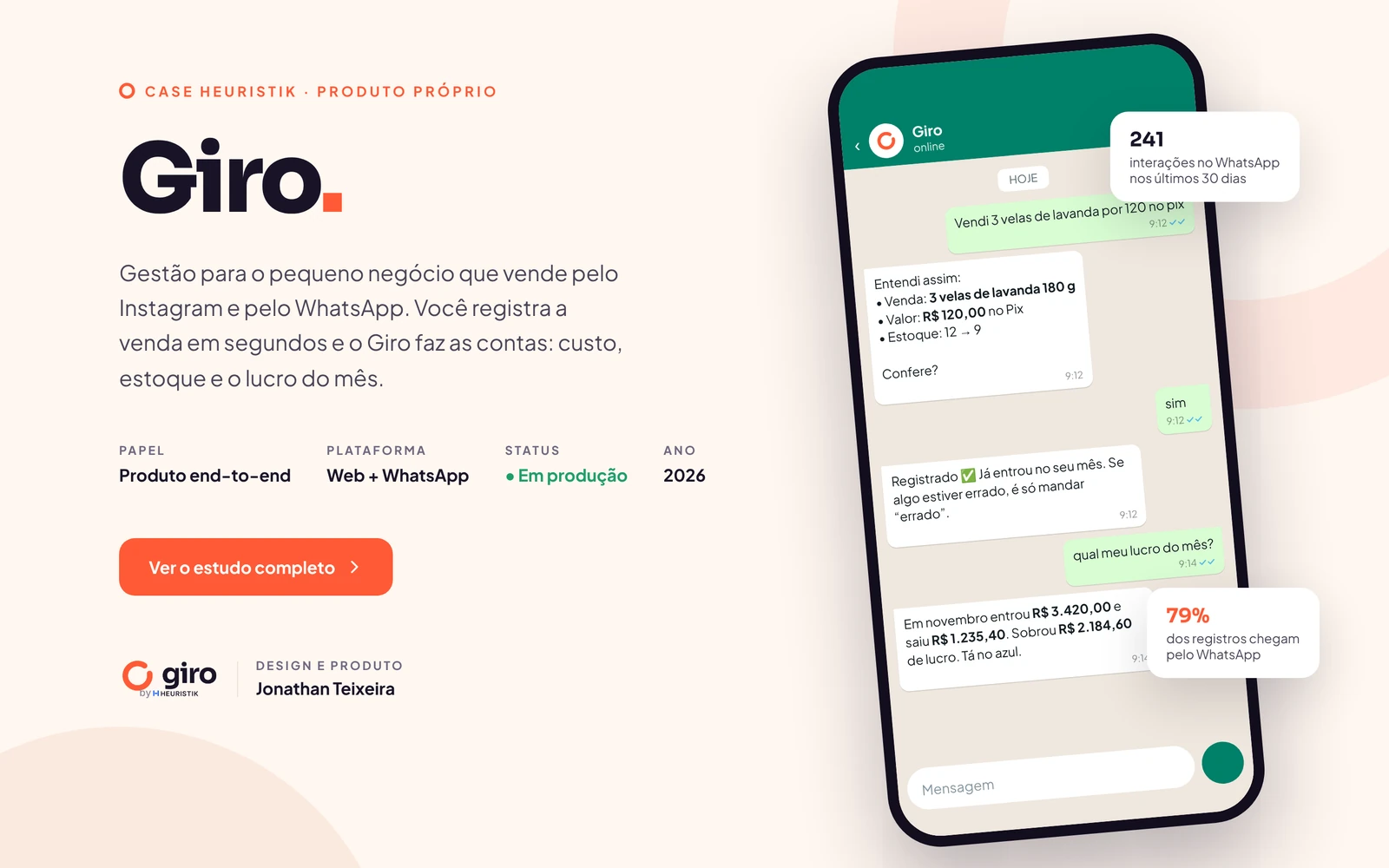
How Heuristik turned a candle brand's spreadsheet into its own SaaS, now in production, that calculates cost, inventory and monthly profit from a sentence like "sold 3 candles for 120".
- Client
- Giro
- Services
- Strategy and business model, Brand, Product design, Product development with AI, Continuous validation
- Timeline
- Sep to Nov 2026, continuously evolving
- Team
- Heuristik end to end, in-house product
The beginning
The idea was born inside a real operation
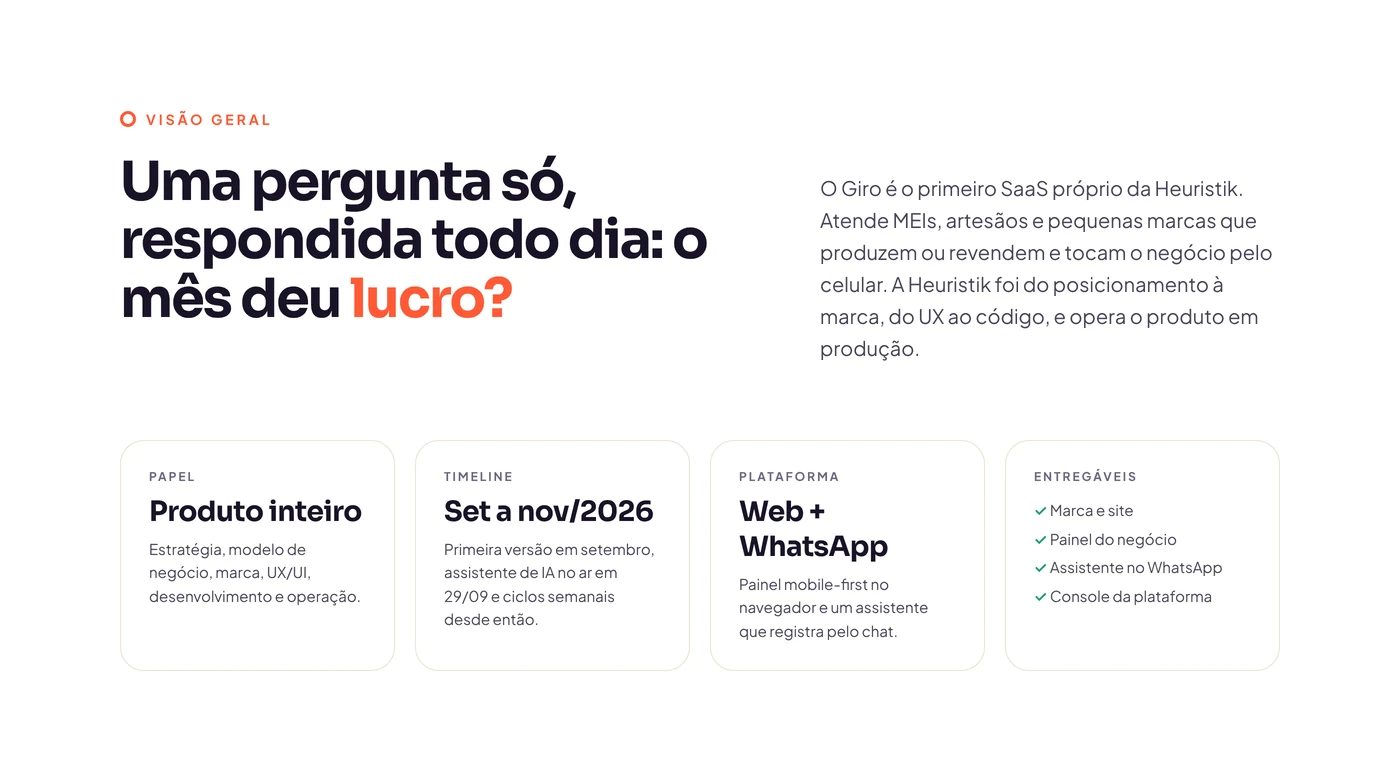
Lumini, the scented candle brand owned by Heuristik's founder, was run on a spreadsheet. Each production batch had a different cost, the price of wax changed with every purchase, and no one knew for sure how much was left over from each candle sold.
The internal system that solved this raised a bigger question: how many small businesses live with exactly the same problem? Bakers, artisans, cosmetics brands, shop owners reselling on Instagram. They all sell over WhatsApp, and almost none of them can say whether the month turned a profit.
That's how Giro was born, Heuristik's first in-house SaaS. Lumini became the pilot operation, the first business on the platform, and the product went live in September 2026.
The problem behind the idea
There's no shortage of systems. The logging just doesn't happen.
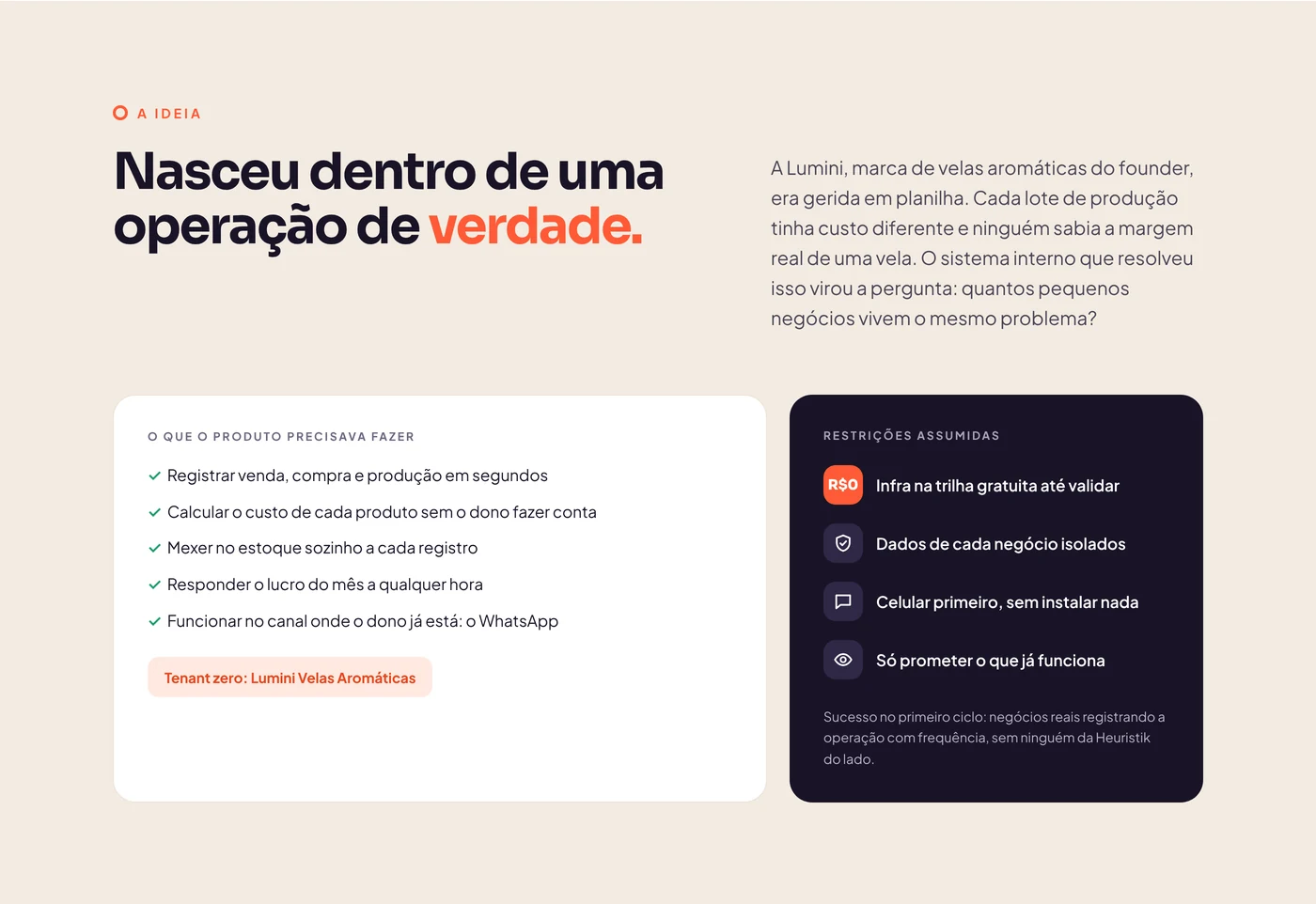
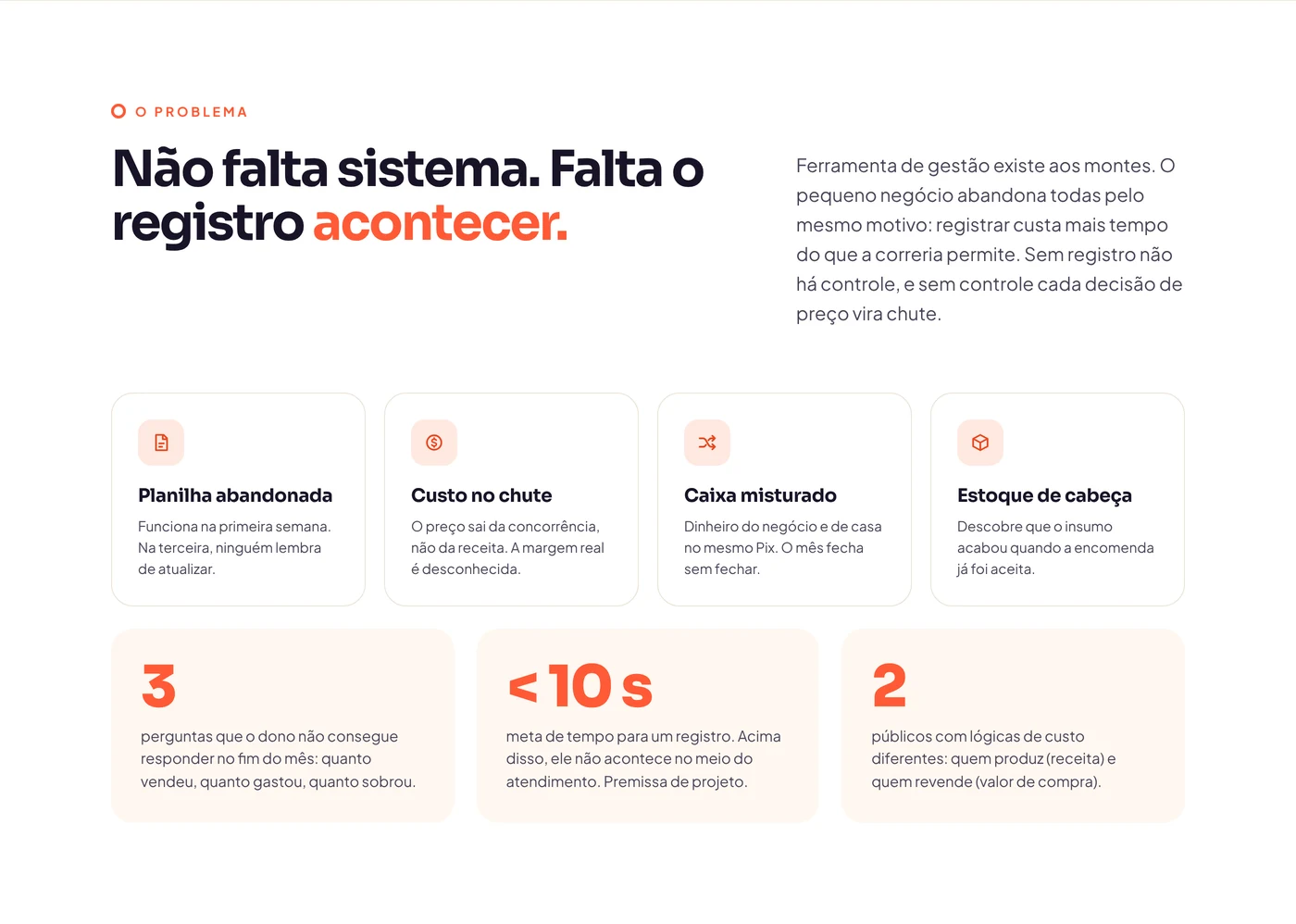
There's no shortage of management tools. Small businesses abandon all of them for the same reason: logging takes more time than the daily rush allows.
- 01
Abandoned spreadsheet
It works the first week. By the third, nobody remembers to update it.
- 02
Costs by guesswork
Prices come from the competition, not from the recipe. The real margin on each product is unknown.
- 03
Mixed cash
Business and household money in the same Pix account. The month ends, but the numbers never add up.
- 04
Inventory from memory
Supplies run out and the owner only finds out after the order has already been accepted.
- 05
Two audiences, two logics
Makers calculate cost from the recipe. Resellers, from what they paid. A system that speaks only one of these languages loses the other half.
What Heuristik did
From positioning to code, in five workstreams
An in-house product, built end to end by Heuristik and run in production from day one.
- Etapa 01
Strategy and business model
A defined audience, a one-sentence value proposition, "know whether your month turned a profit", and a freemium model: the dashboard is free forever, and the WhatsApp assistant is the upgrade, with a 30-day trial. The people who pay are the ones who have already felt the value.
- Etapa 02
Brand created from scratch
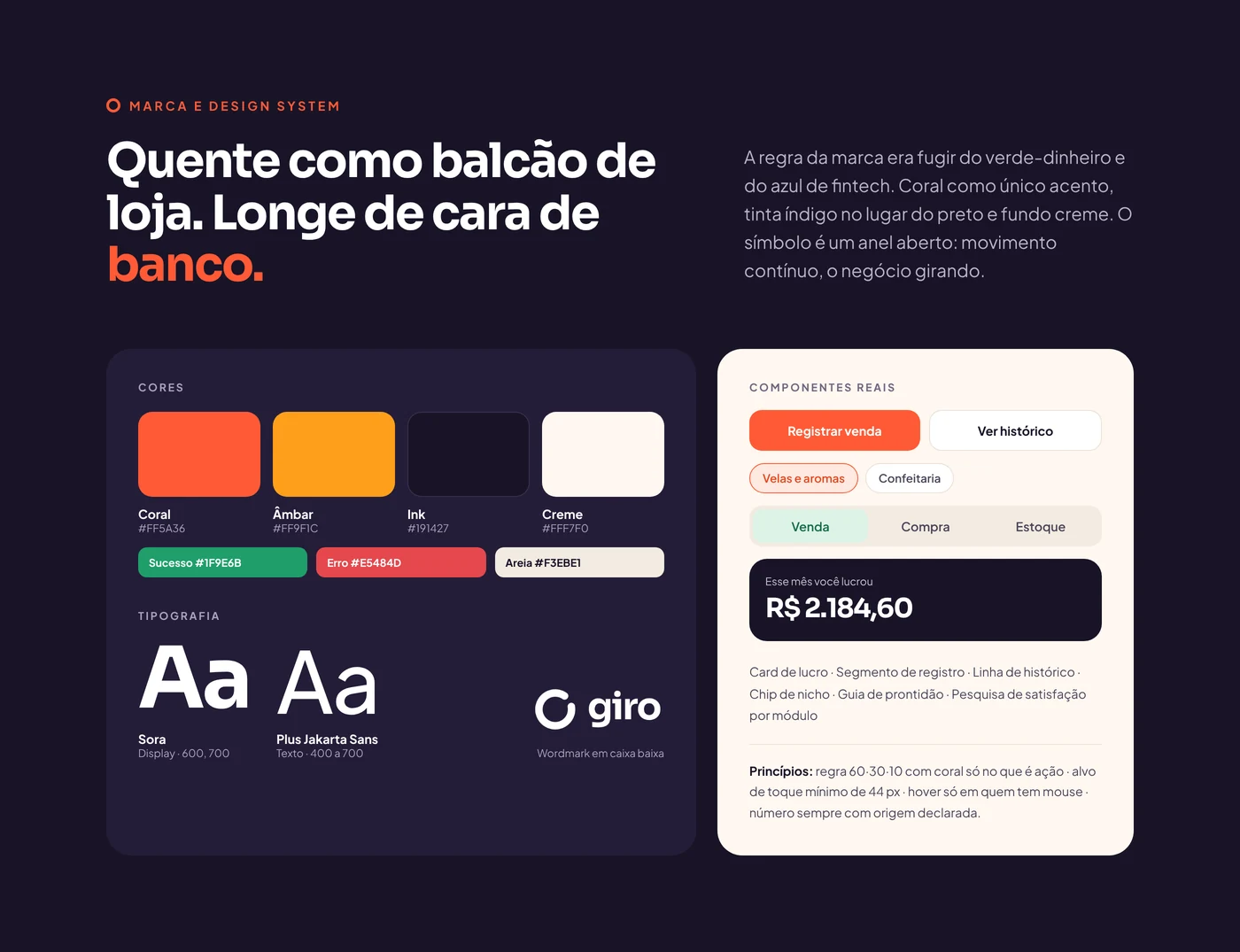
The rule was to steer clear of money green and the look of a bank. Coral as the only accent, indigo ink instead of black, a cream background and a symbol shaped like an open ring, the business turning.
- Etapa 03
Product and interface
A mobile-first dashboard, with the main journeys designed to fit between one customer and the next.
- Open demo, no sign-up: people see the product from the inside before creating an account
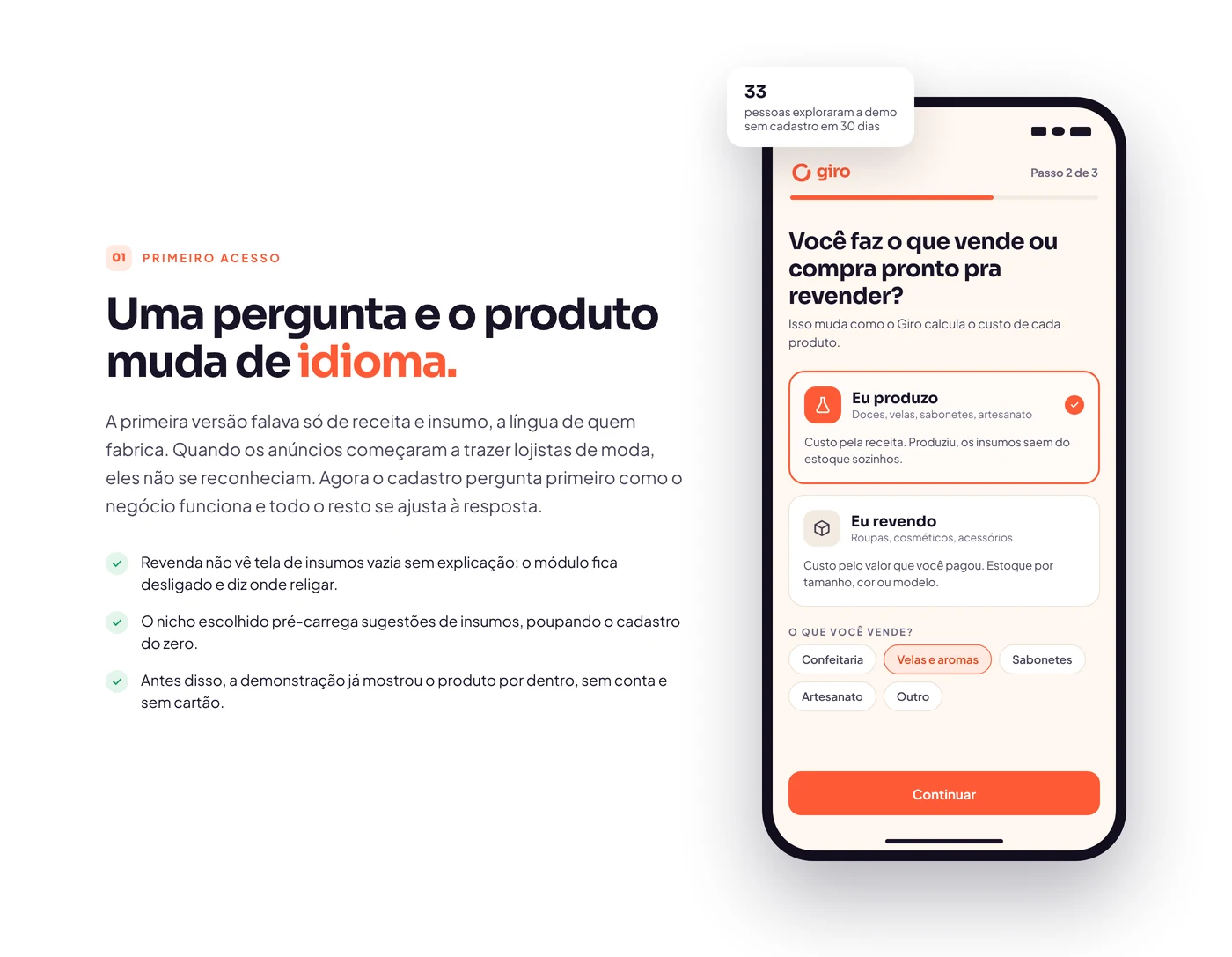
- First-time setup that asks whether the business makes or resells, and adapts the product to the answer
- Catalog with recipes: each product's cost comes from its supplies, not from a loose number
- Transactions on a single screen, with the impact on inventory shown before confirming
- A home screen that opens with a sentence and a number: this month, you made a profit
- Etapa 04
The WhatsApp assistant
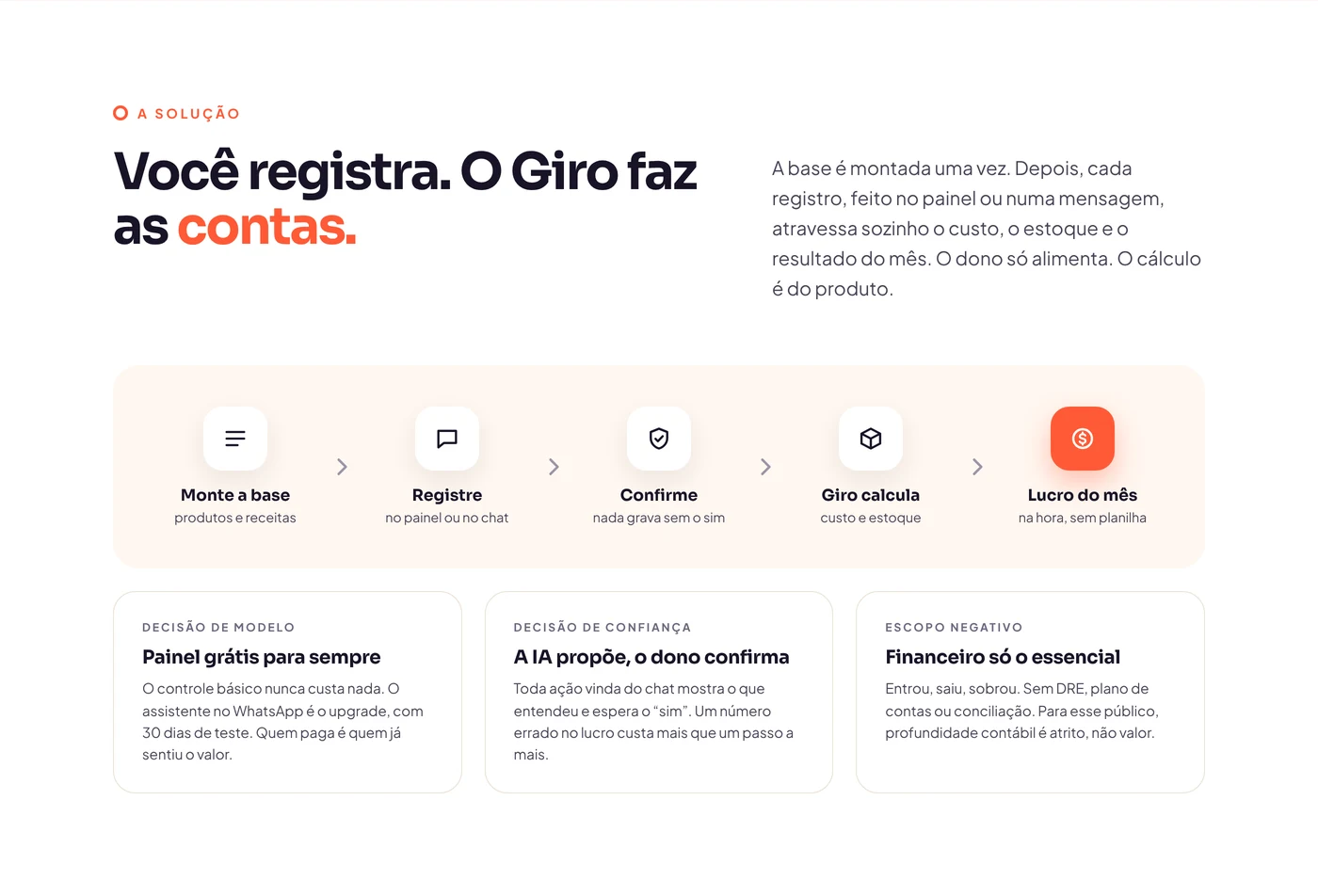
"Sold 3 lavender candles for 120 via Pix" becomes a logged sale. A photo of the supplier's receipt becomes a supplies entry with updated costs. And "what's my profit this month?" gets an instant answer. Nothing is saved without the owner's confirmation.
- Etapa 05
Continuous validation in production
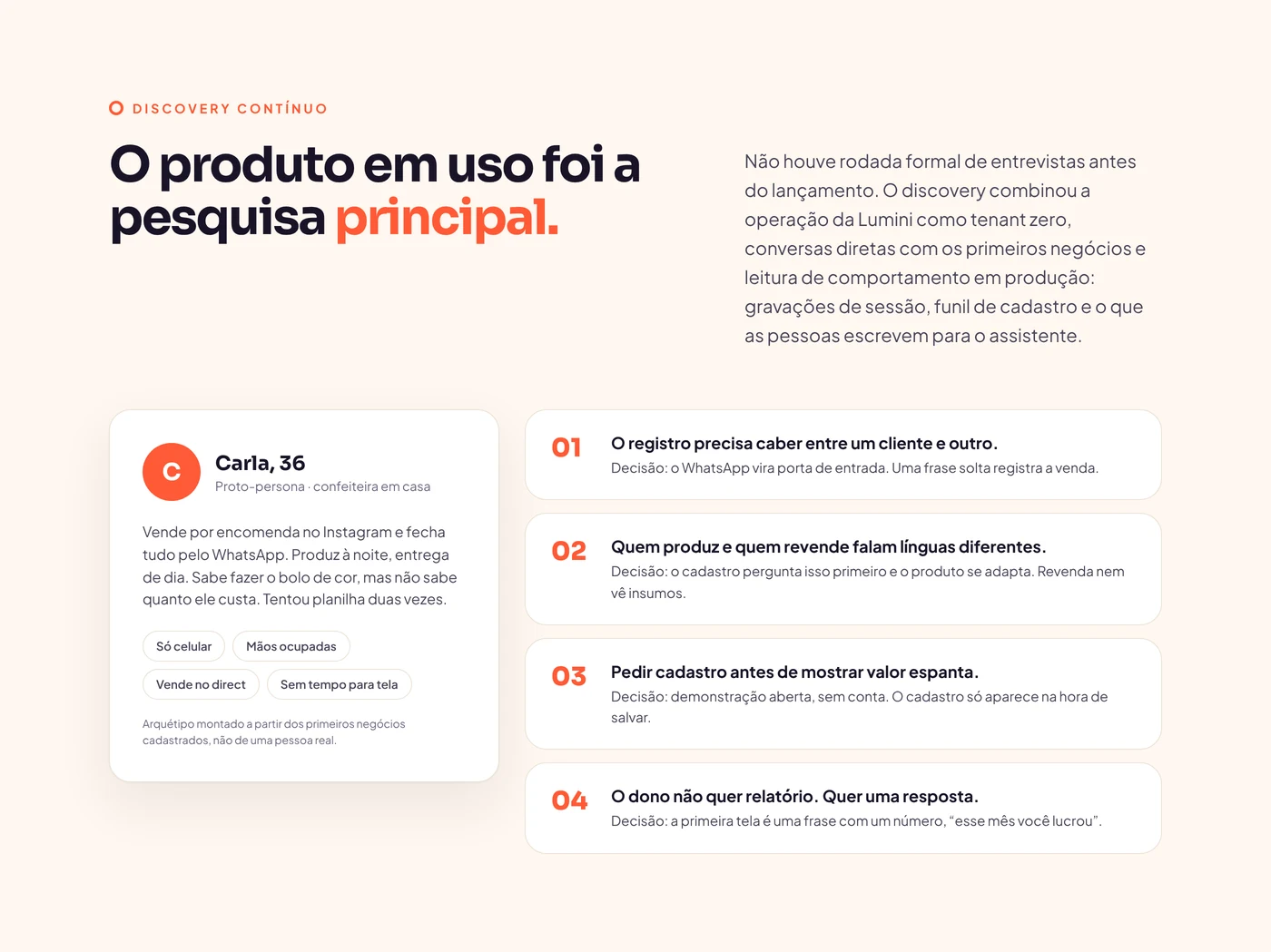
There was no formal interview round before launch, and saying so openly is worth more than pretending research happened when it didn't. Discovery came from the pilot operation, conversations with the first businesses, session recordings and the sign-up funnel. That's how October's two most important changes came about: the first-time setup that separates makers from resellers, and the no-sign-up demo.
The solution
You log it. Giro does the math.
What discovery showed, how the product responds to it and the brand that holds it all together.
The screens
The main journeys, screen by screen
From first-time setup to the WhatsApp conversation, the five moments that support daily use.
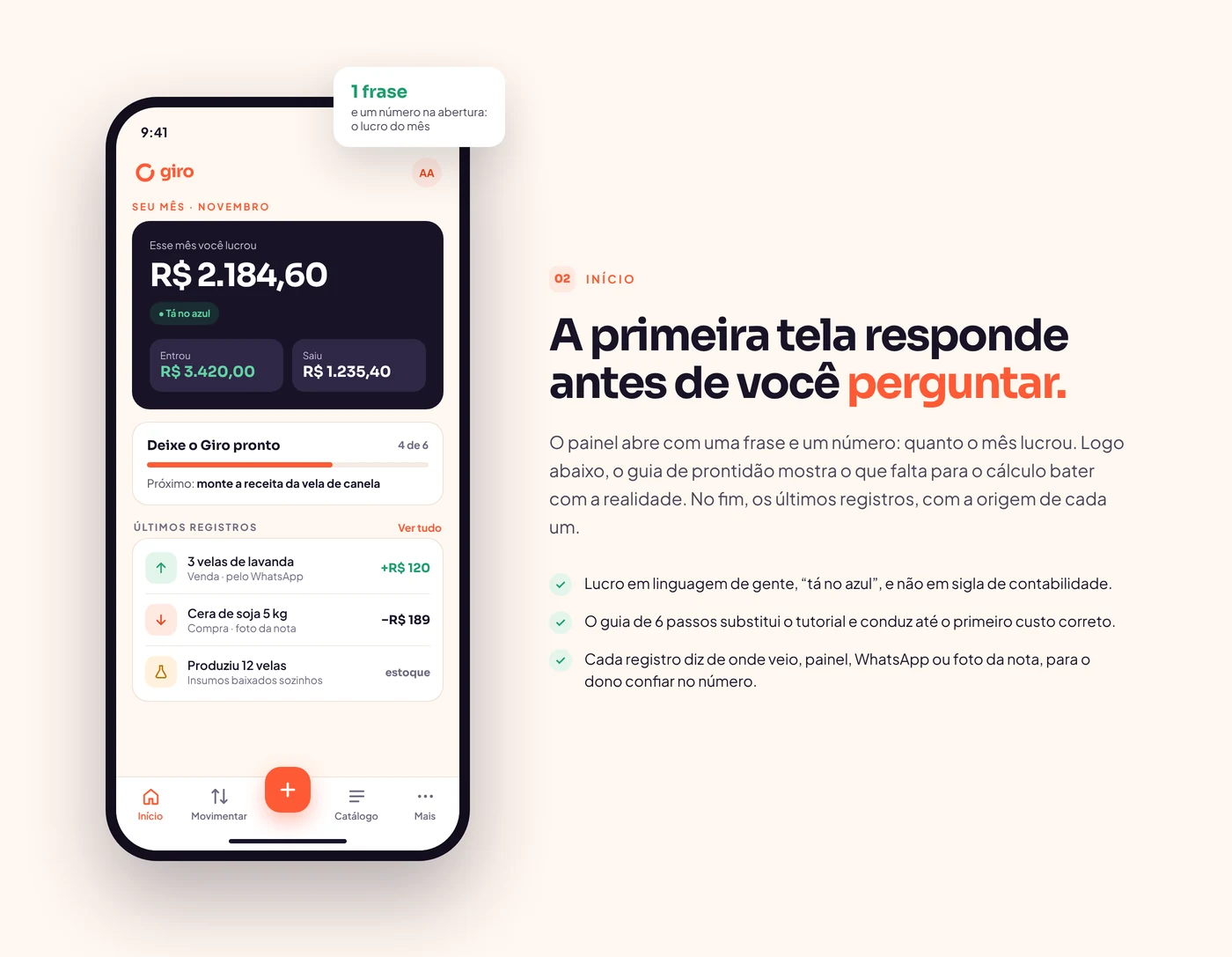
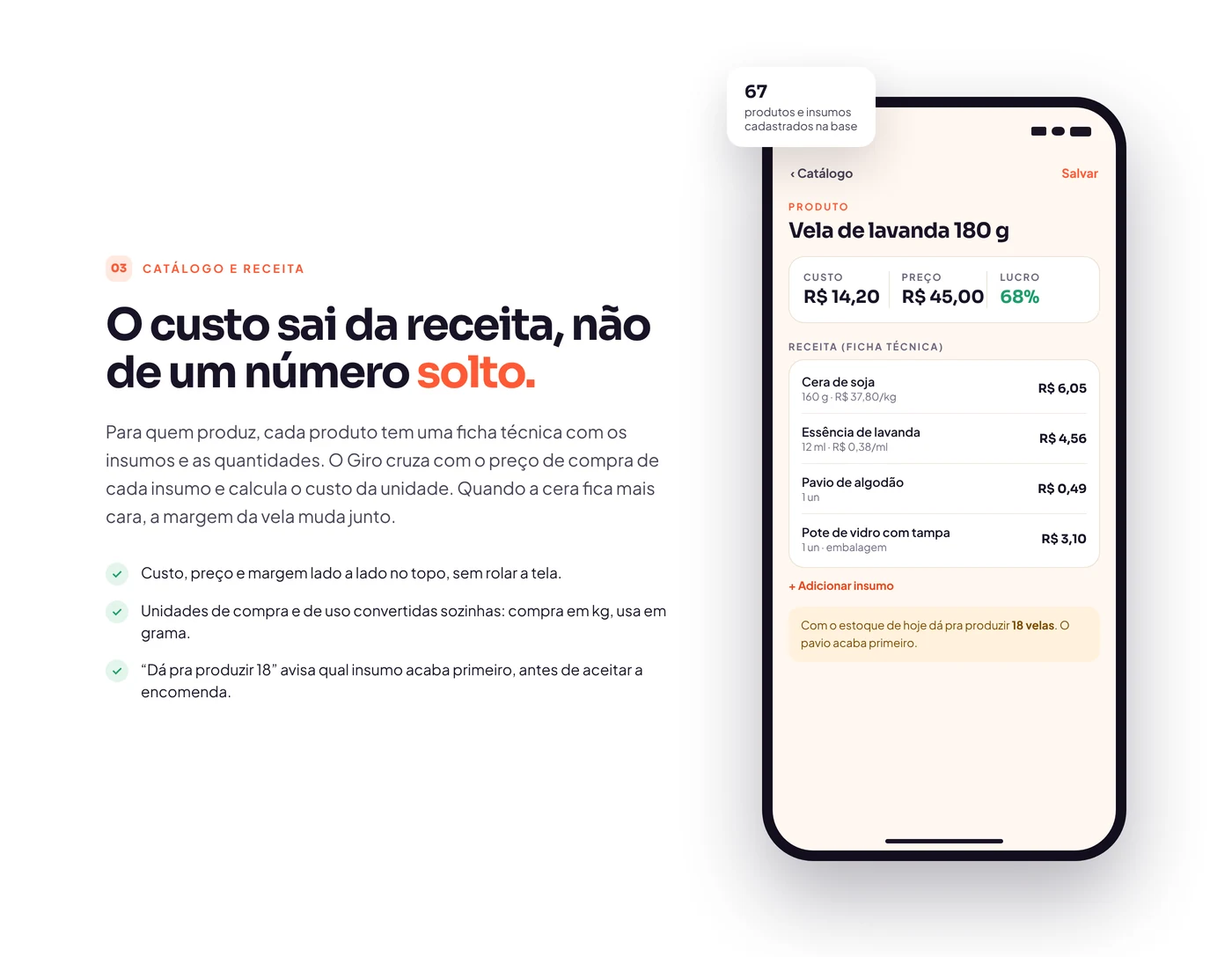
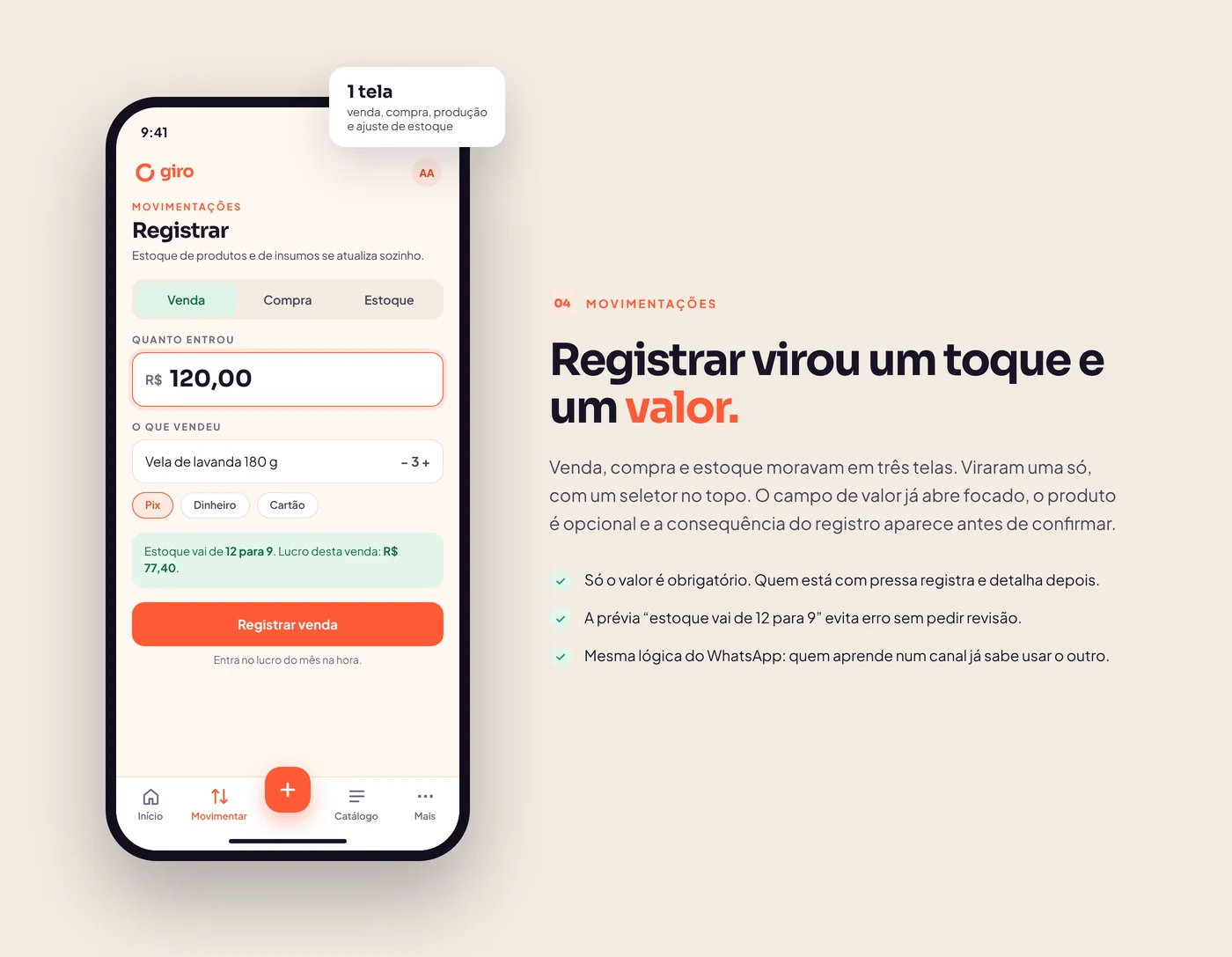
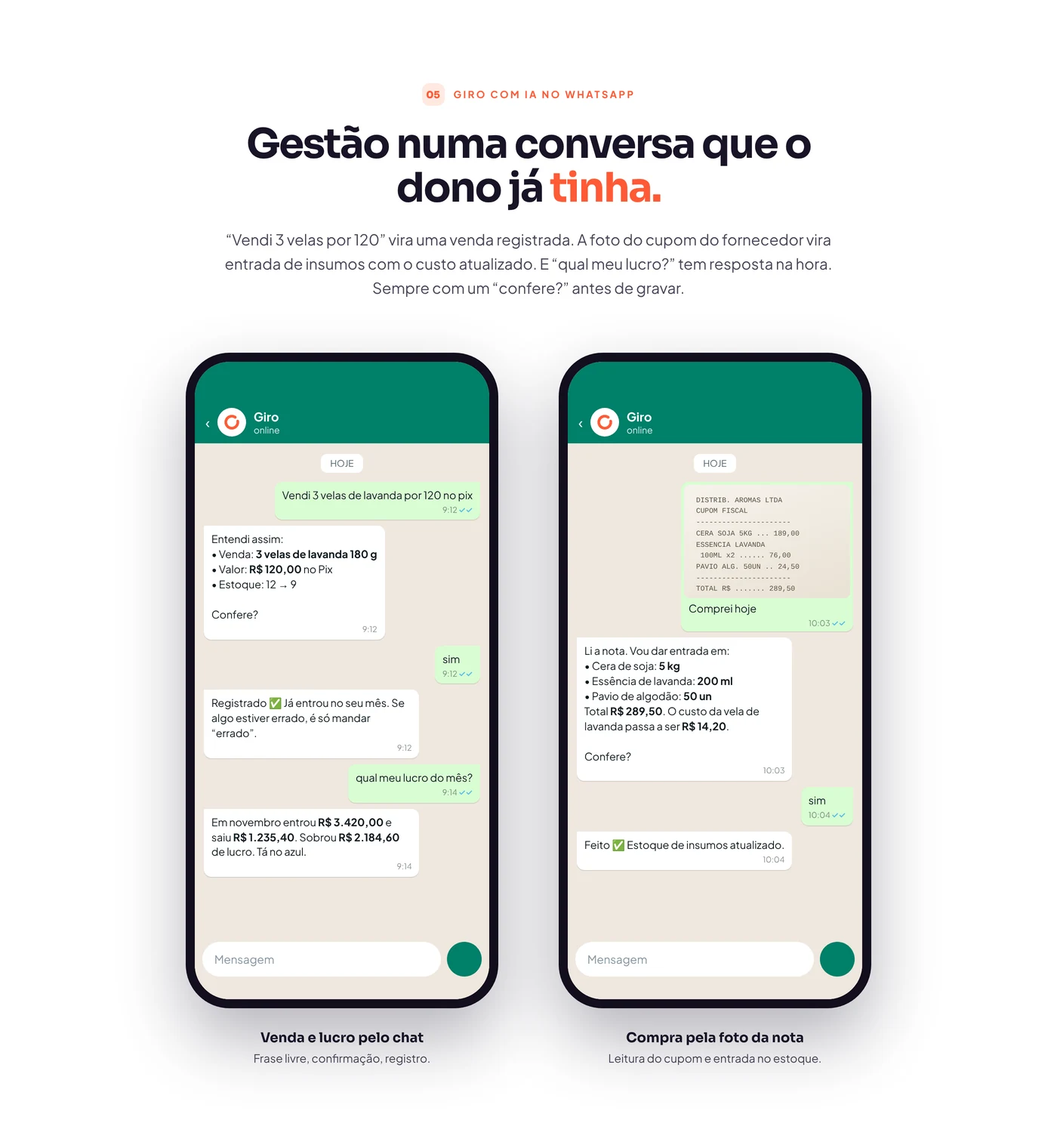
Inside the assistant
Rules first, AI next, the owner last
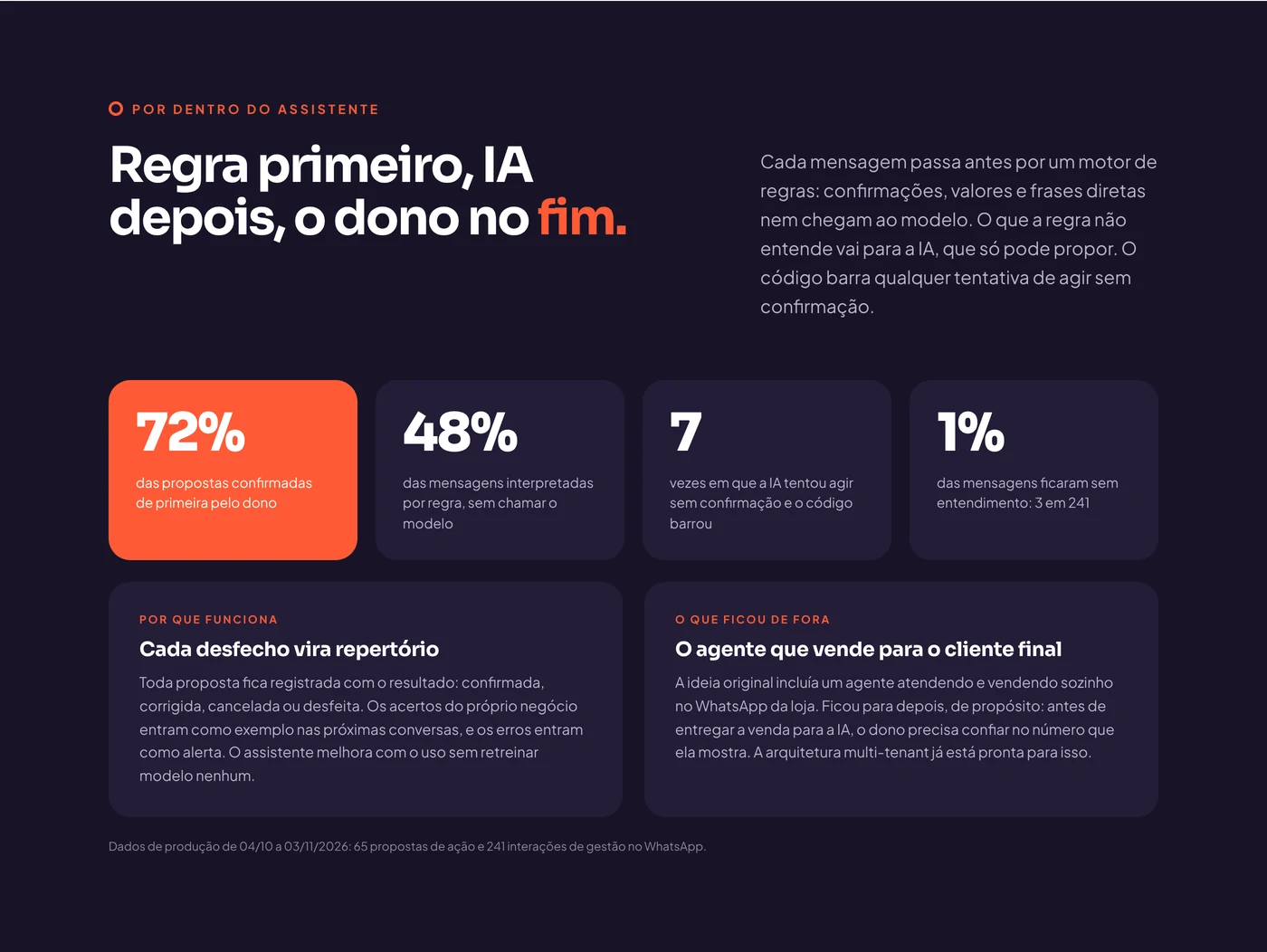
Every message first goes through a rules engine: confirmations, amounts and straightforward phrases never even reach the AI model, which makes responses faster and operating costs lower. Whatever the rules can't understand goes to the AI, which can only propose an action. The code blocks any attempt to save without confirmation.
Each proposal is logged with its outcome: confirmed, corrected, canceled or undone. The business's own correct entries are used as examples in later conversations. The assistant improves with use, without retraining any model.
What was left out, on purpose: an agent that serves and sells to the end customer on its own. Before handing sales over to AI, the owner needs to trust the number it shows.
The result
Live, with real businesses logging
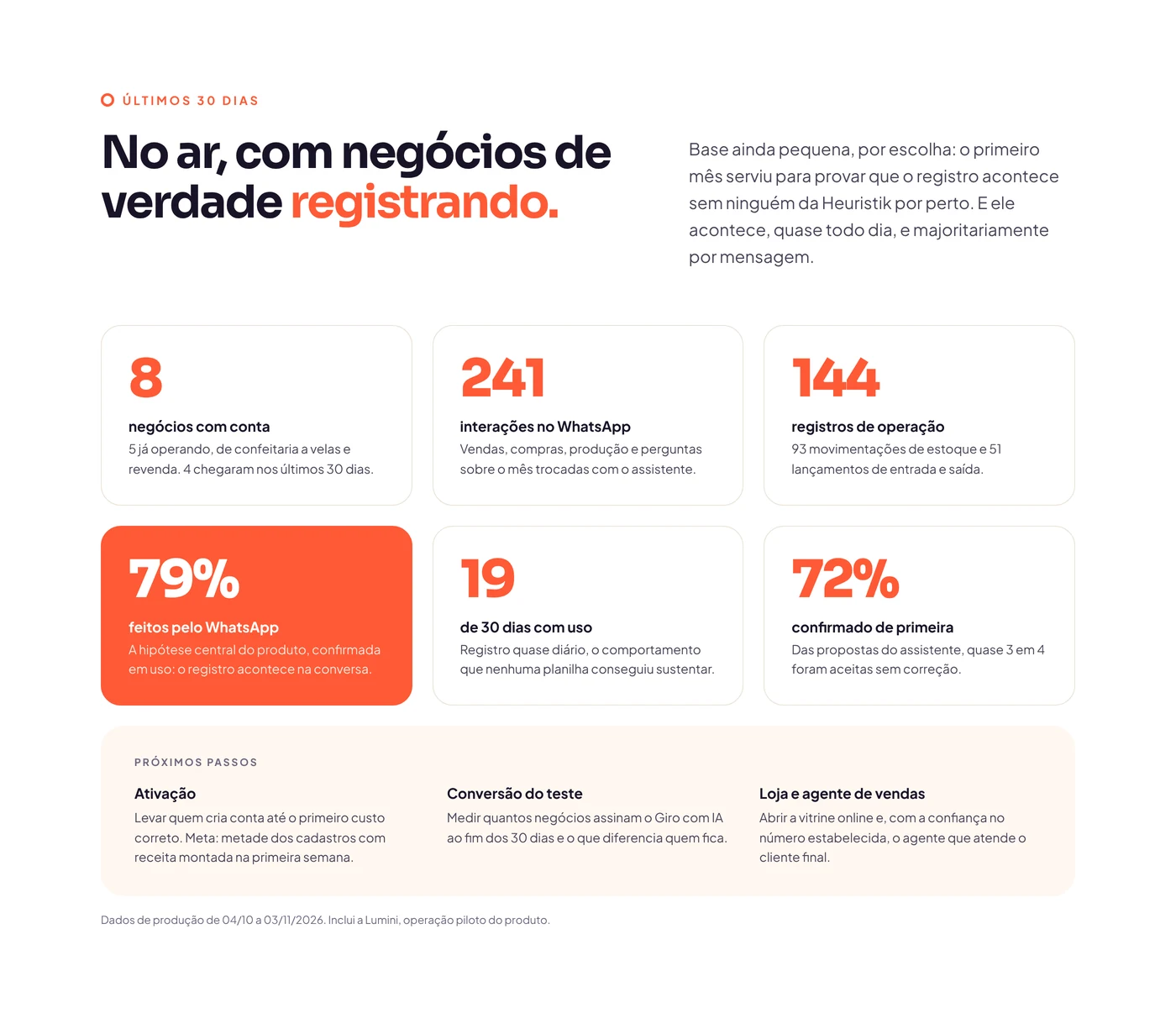
Production numbers from the last 30 days, October 4 to November 3, 2026. The base is still small, by choice: the first month served to prove that logging happens when it fits in a message. Includes Lumini, the product's pilot operation.
- Businesses with an account
- 8Businesses with an account5 already operating, from bakeries to candles and resale. 4 joined in the last 30 days.
- WhatsApp interactions
- 241WhatsApp interactionsSales, purchases, production and questions about the month exchanged with the assistant.
- Operational entries
- 144Operational entries93 inventory movements and 51 income and expense entries.
- Made via WhatsApp
- 79%Made via WhatsAppThe product's core hypothesis, confirmed in use.
- Days with usage
- 19 of 30Days with usageNear-daily logging, something no spreadsheet ever managed to sustain.
- Confirmed on the first try
- 72%Confirmed on the first tryOf the assistant's proposals, almost 3 in 4 were accepted without correction.
Learnings
What carries over to other products
- 01
The channel decides whether the data exists
The same entry nobody makes on a screen gets made effortlessly in a message.
- 02
AI proposes, people confirm
When the number is money, an extra confirmation step is worth more than speed.
- 03
Rules before models
Almost half of all messages are resolved without AI, with faster responses and lower cost.
- 04
A product in use is the best research
The month's two most important changes came from real behavior, not assumptions.
Services applied
What was hired in this project
- Product strategy and business model
- Brand creation and visual identity
- Product and interface design
- Product development with integrated AI
- Continuous validation with production usage data
- 04
Strategic Consulting
Product positioning, roadmap and strategic direction. For founders and PMs who need clarity before scaling.
- 02
Product Design
Wireframes, prototypes and design systems focused on conversion. Every screen is designed with intent: clear hierarchy, intuitive flow, zero noise.
- 03
Continuous Validation
Usability testing, metrics and evidence-based iteration. We don't deliver and disappear. We measure impact, learn and adjust.
Questions
Frequently asked questions about this work
What people usually ask before hiring a project like this one.
What is Giro?
It's a management system for small businesses that make or resell products. The owner logs sales, purchases and production in the dashboard or by WhatsApp message, and Giro calculates each product's cost, the inventory and the monthly profit.
Does Heuristik also build the product, or only design it?
On Giro, Heuristik did everything: strategy, brand, interface, code and operations. On client projects, the scope can range from product design to delivery alongside the client's development team.
Can I add AI to my product without an AI team?
Yes. In Giro, AI comes in at one specific point of the journey, with rules before it and confirmation after. That design keeps cost and errors under control, and it works for other products too.
How long did it take for Giro to go live?
The first version went into production in September 2026, and the WhatsApp assistant launched at the end of that same month. Since then, the product has evolved in weekly cycles.
How do you measure whether the product is working?
Through behavior in production: how many businesses log entries, how often, through which channel and how many of the assistant's proposals are confirmed without correction.
Other case studies
View all- Sports events
NovoTicket
A full review of the platform that sells race registrations across Brazil, from the runner's cart to the race organizer's dashboard.
- Beauty subscription
HairClub Brasil
A beauty subscription platform designed for two audiences at once: the people who subscribe to a plan and the partner salons that serve them.
- Conscious consumption
Vida Sem Teste
An open platform that answers in seconds a question that used to take half an hour of research: does this brand test on animals?
Next step
Have a product idea stuck in a spreadsheet?
That's how Giro started. Heuristik turns a real operation's problem into a product, with method, validation and usage numbers to show for it.