Beauty subscription / 2026
HairClub Brasil, the beauty subscription platform with two journeys inside the same app
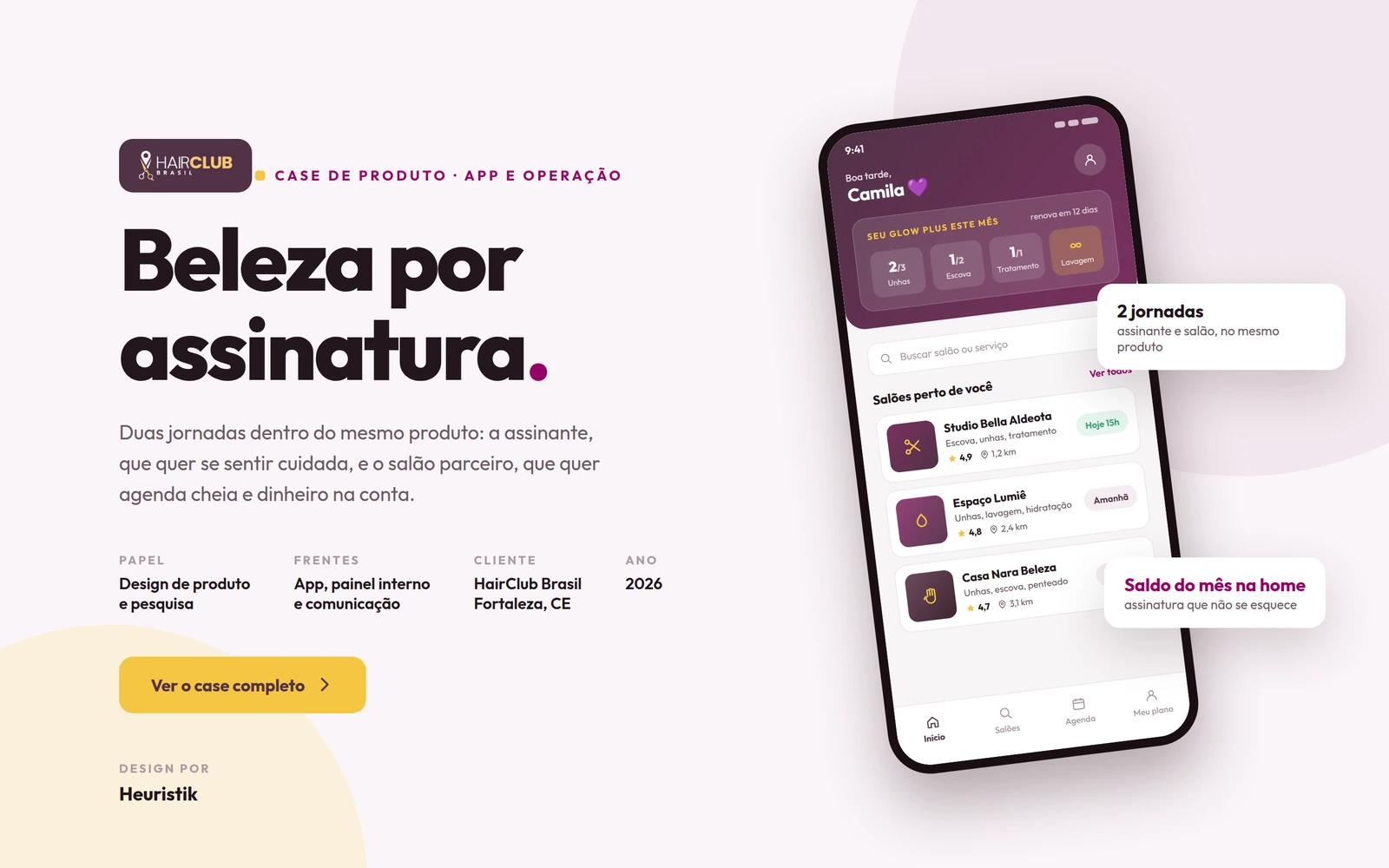
How Heuristik redesigned the offer, the screens and the customer service of a beauty subscription club, balancing what subscribers need to see and what partner salons need to receive, with research backing every decision.
- Client
- HairClub Brasil
- Services
- User research, Product design, Design system, Customer service automation
- Timeline
- 2026
- Industry
- Beauty subscription
The beginning
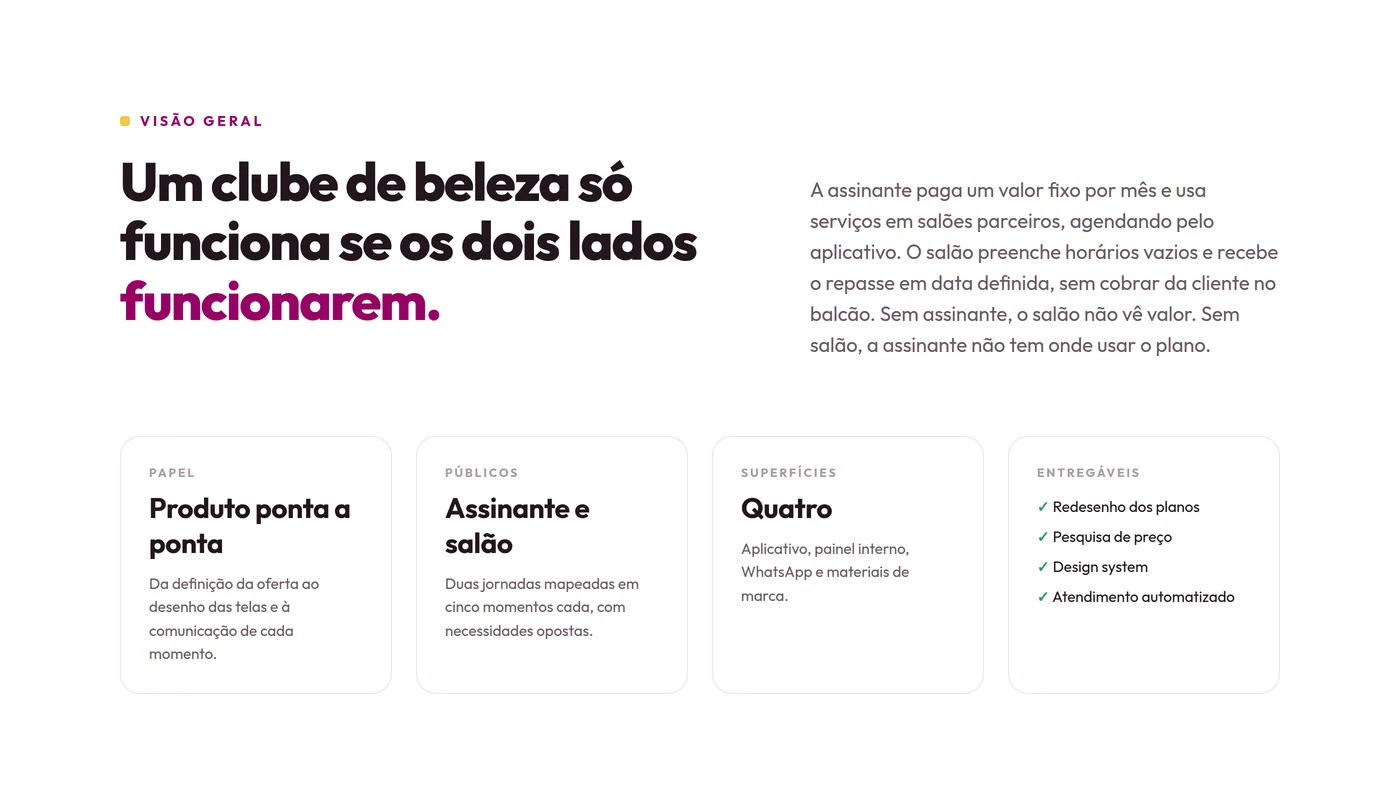
A beauty club only works if both sides work
HairClub works like a club: members pay a fixed monthly fee and use beauty services at partner salons, booking everything through the app. Manicures, blowouts, deep conditioning, hair washes.
But there are two different people in this story, with opposite expectations.
On one side, the subscriber, who wants to feel cared for, find a nearby salon and book in a few taps. On the other, the partner salon, which wants a full schedule during empty hours and the certainty of receiving its payout on the agreed date.
A product that serves only one of them doesn't work. Without subscribers, the salon sees no value. Without salons, subscribers have nowhere to use their plan. That balance is what we designed.
What was holding it back
A product growing faster than its own organization
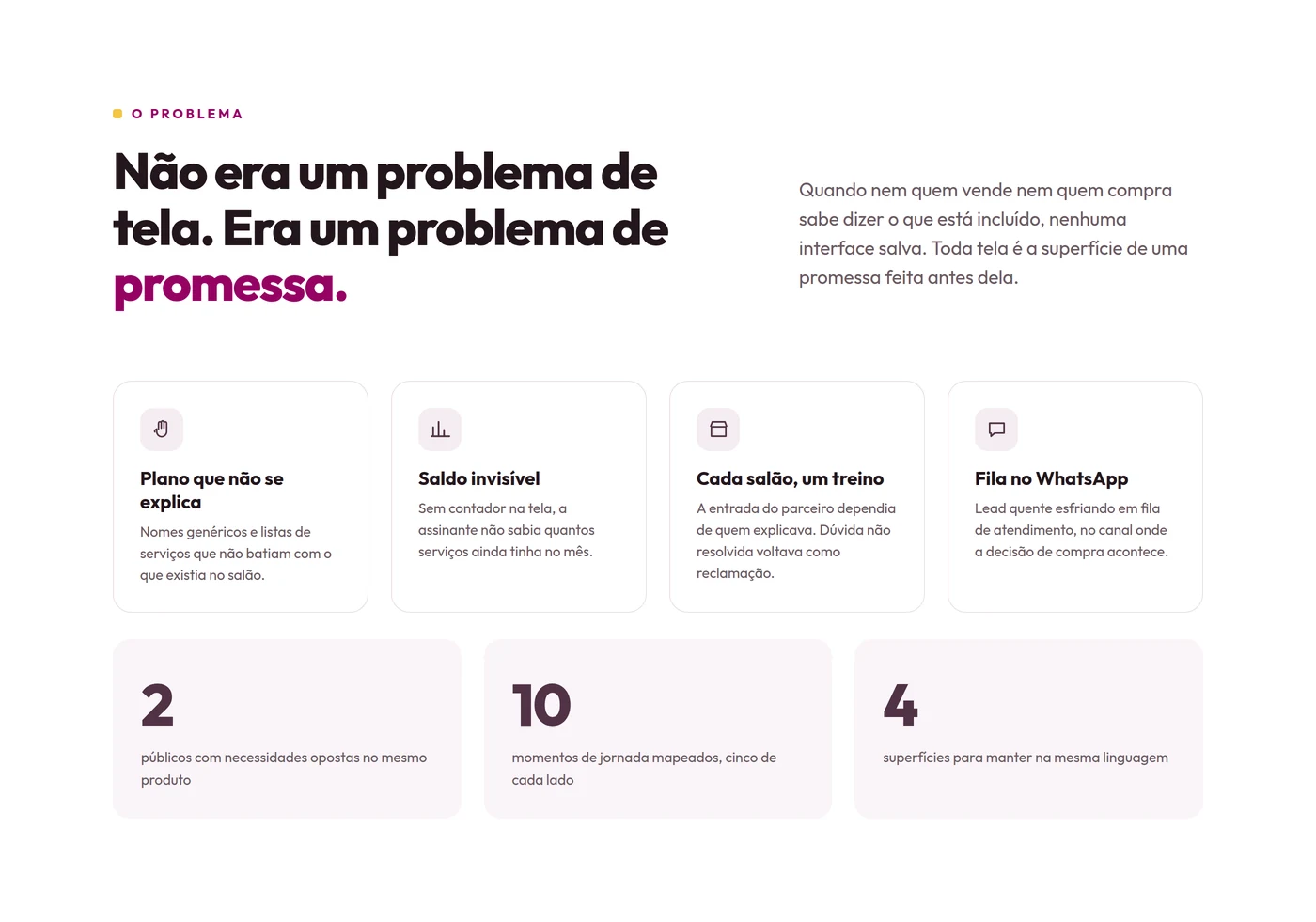
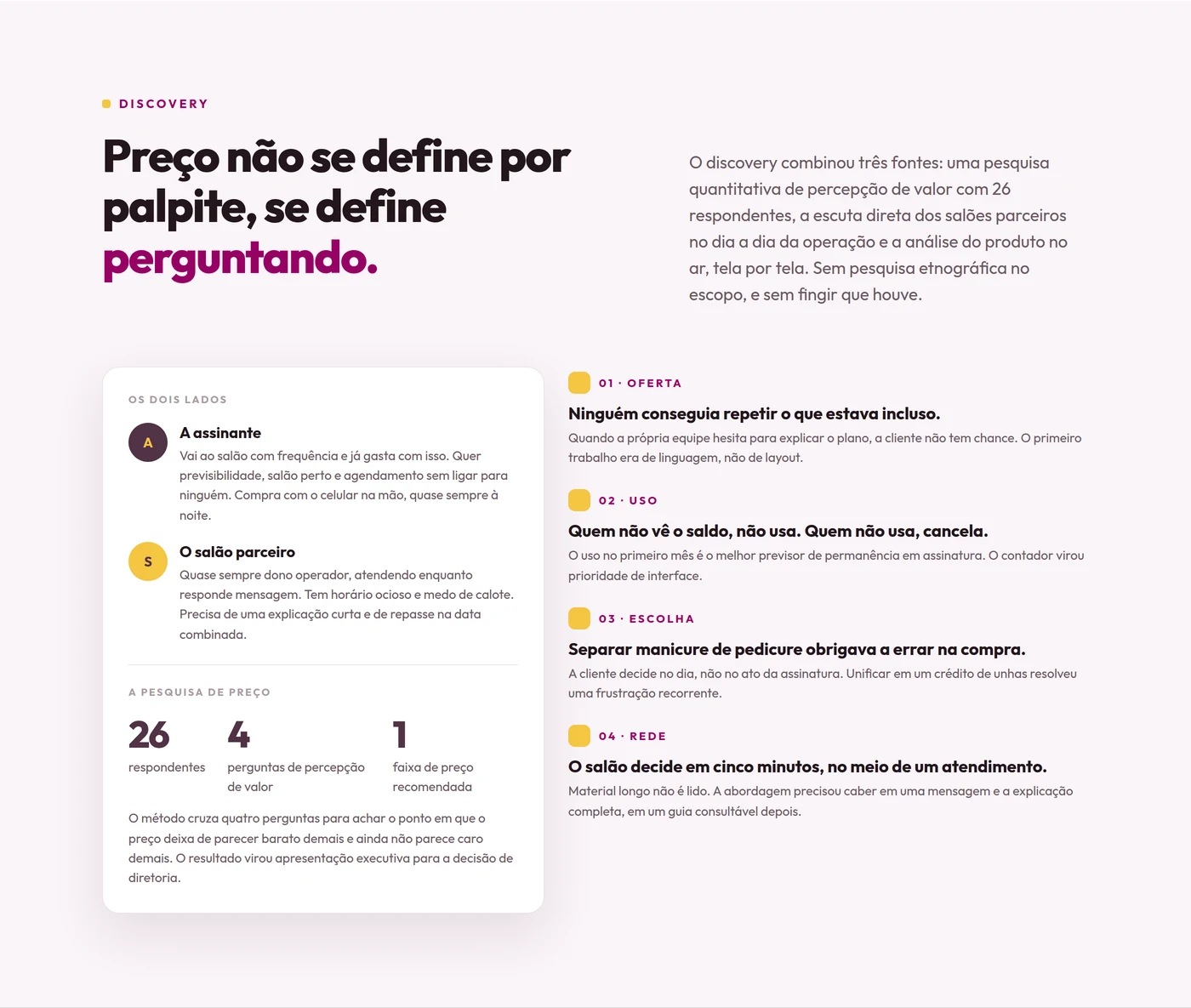
None of these issues show up as errors in the system. They all show up as cancellations, support tickets and partners who don't understand their own business.
- 01
A plan that doesn't explain itself
Generic names and service lists that didn't match what the salon actually offered. When the team itself hesitates to explain the plan, the customer doesn't stand a chance.
- 02
Invisible balance
With no counter on screen, subscribers didn't know how many services they had left in the month. They couldn't answer the simplest question any subscriber has.
- 03
Every salon, a different training
Partner onboarding depended on who was doing the explaining. Unresolved questions came back later as complaints, and training didn't scale.
- 04
WhatsApp queue
Hot leads going cold in the service queue, inside the very channel where purchase decisions happen in Brazil.
- 05
The wrong choice at checkout
The credit separated manicures from pedicures and forced subscribers to decide at sign-up what they only decide on booking day.
- 06
A brand with three faces
One email in one purple, a post in another, a document in a third typeface. The communication changed identity with every piece.
The real challenge
It wasn't a screen problem. It was a promise problem.
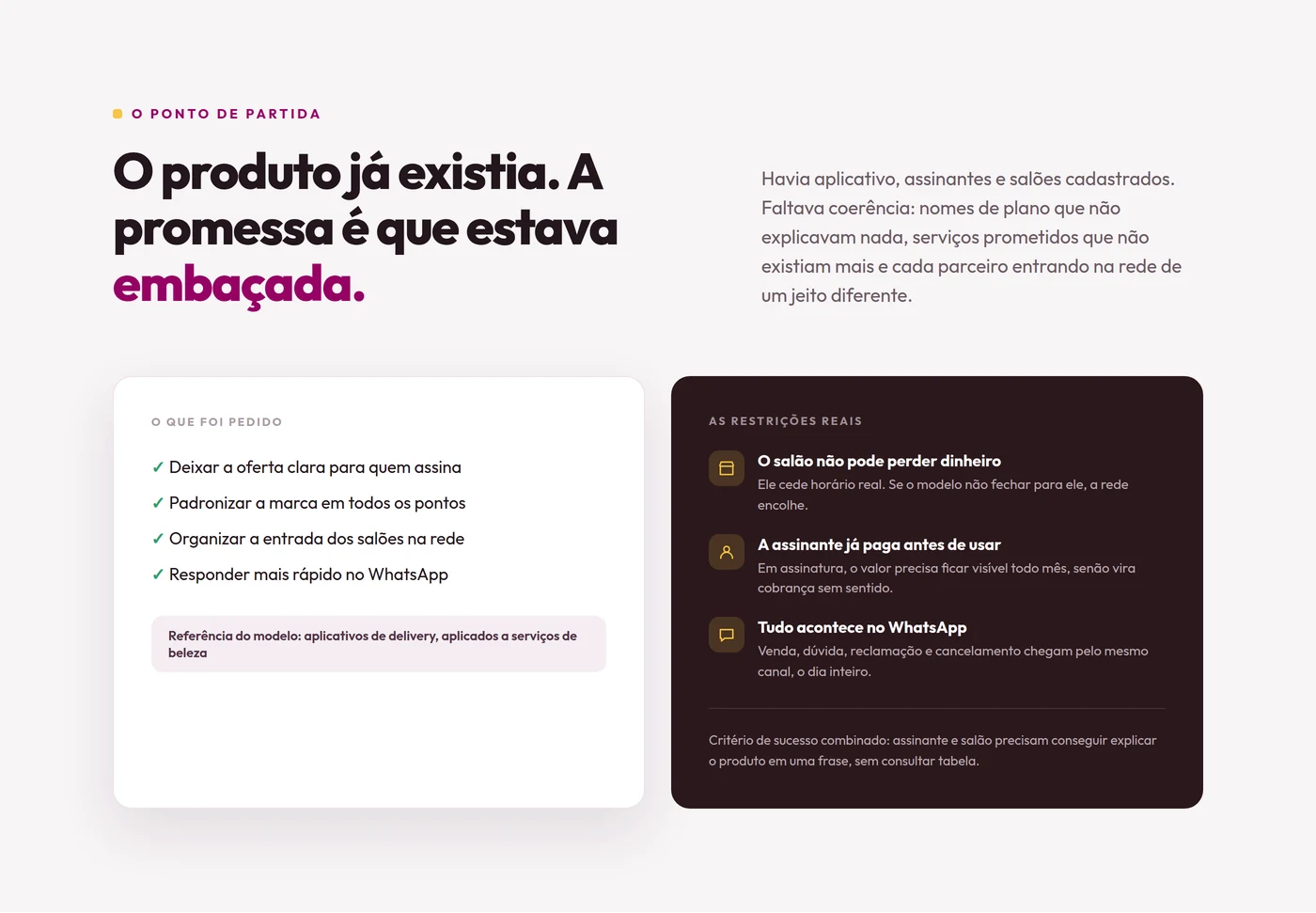
The initial request was about screens and materials. Our reading was different.
The product didn't have an interface problem. It had a promise problem. Subscribers and salons couldn't explain, in one sentence, what they were buying and what they were selling.
Until that was clear, no new screen would fix it, because every screen is just the surface of a promise that has already been made.
What Heuristik did
End-to-end product design, in six workstreams
From defining the offer to designing the screens and the communication for each moment, on both sides of the platform.
- Etapa 01
We mapped both journeys in full
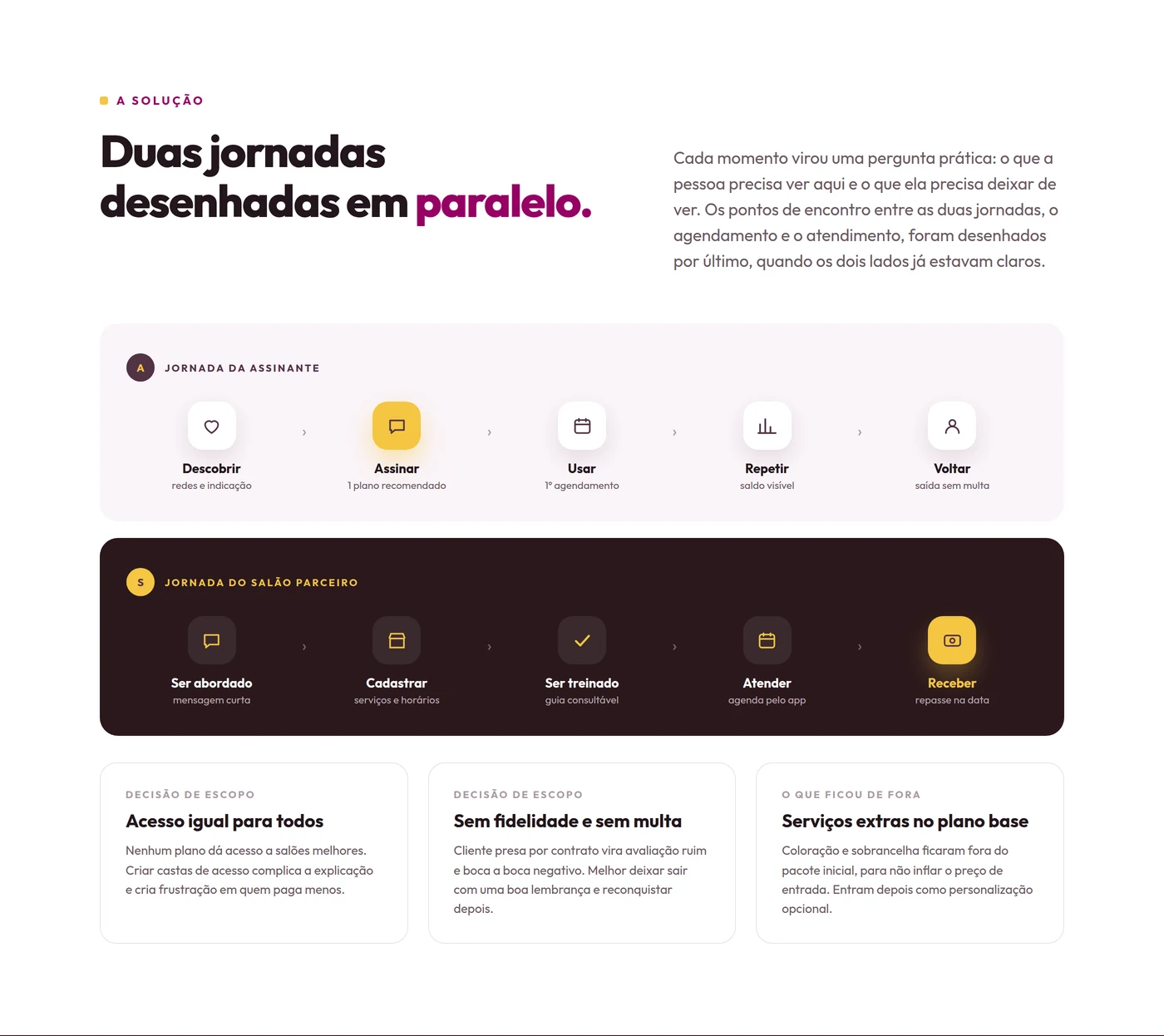
On the subscriber side, five moments: discovering the brand, deciding to subscribe, using it for the first time, continuing month after month and, if they cancel, having a dignified way back. On the salon side, another five: being approached, understanding the model, registering the space, getting trained and operating day to day with predictable payouts. Each of these ten moments became a practical question: what does the person need to see here, and what do they need to stop seeing?
- Etapa 02
We restructured the offer with research, not guesswork
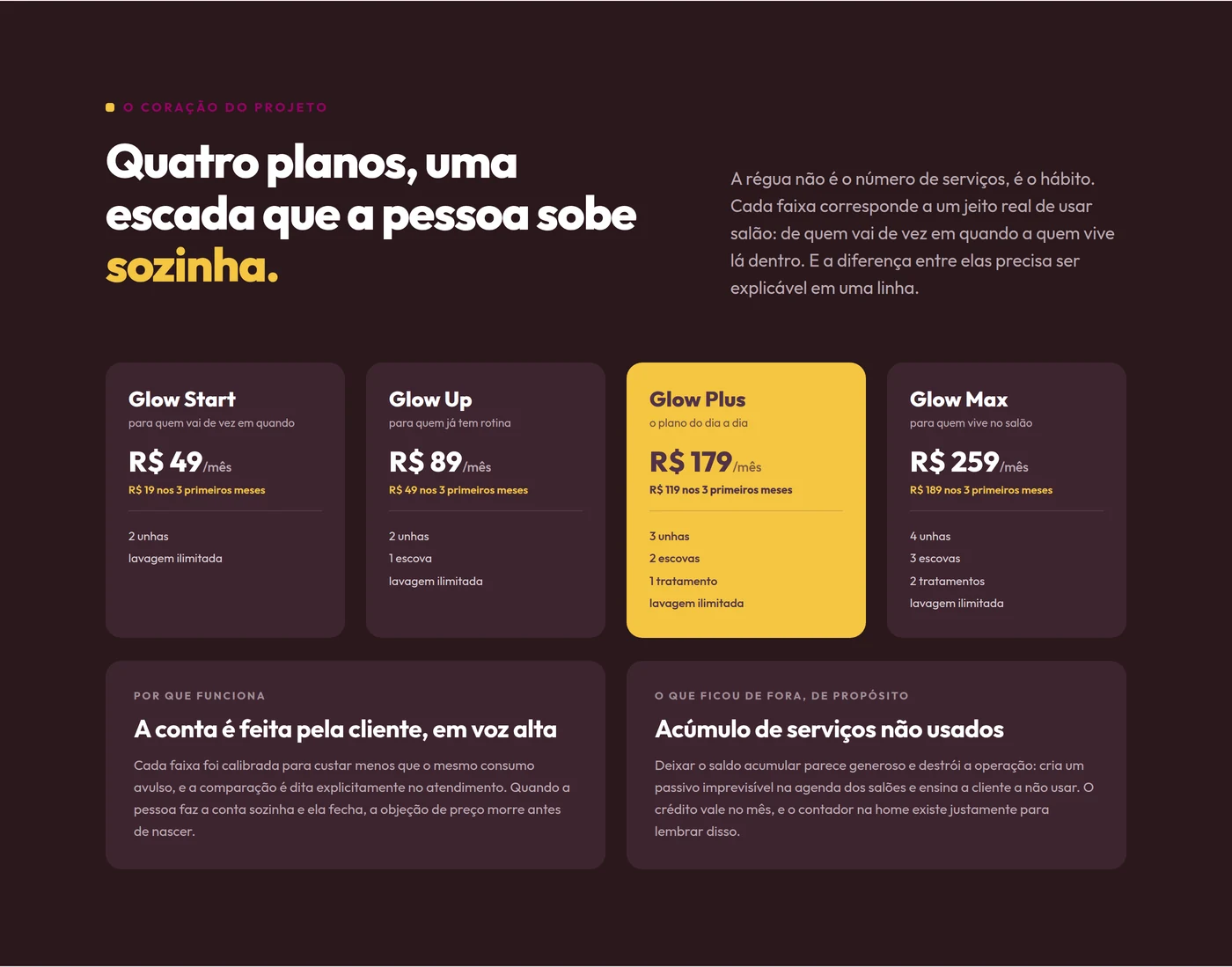
The plans were redesigned into four tiers with self-explanatory names, from lightest to most complete, and with one simple rule: everyone gets access to every partner salon.
- No hidden access levels, because access tiers complicate the explanation and frustrate those who pay less
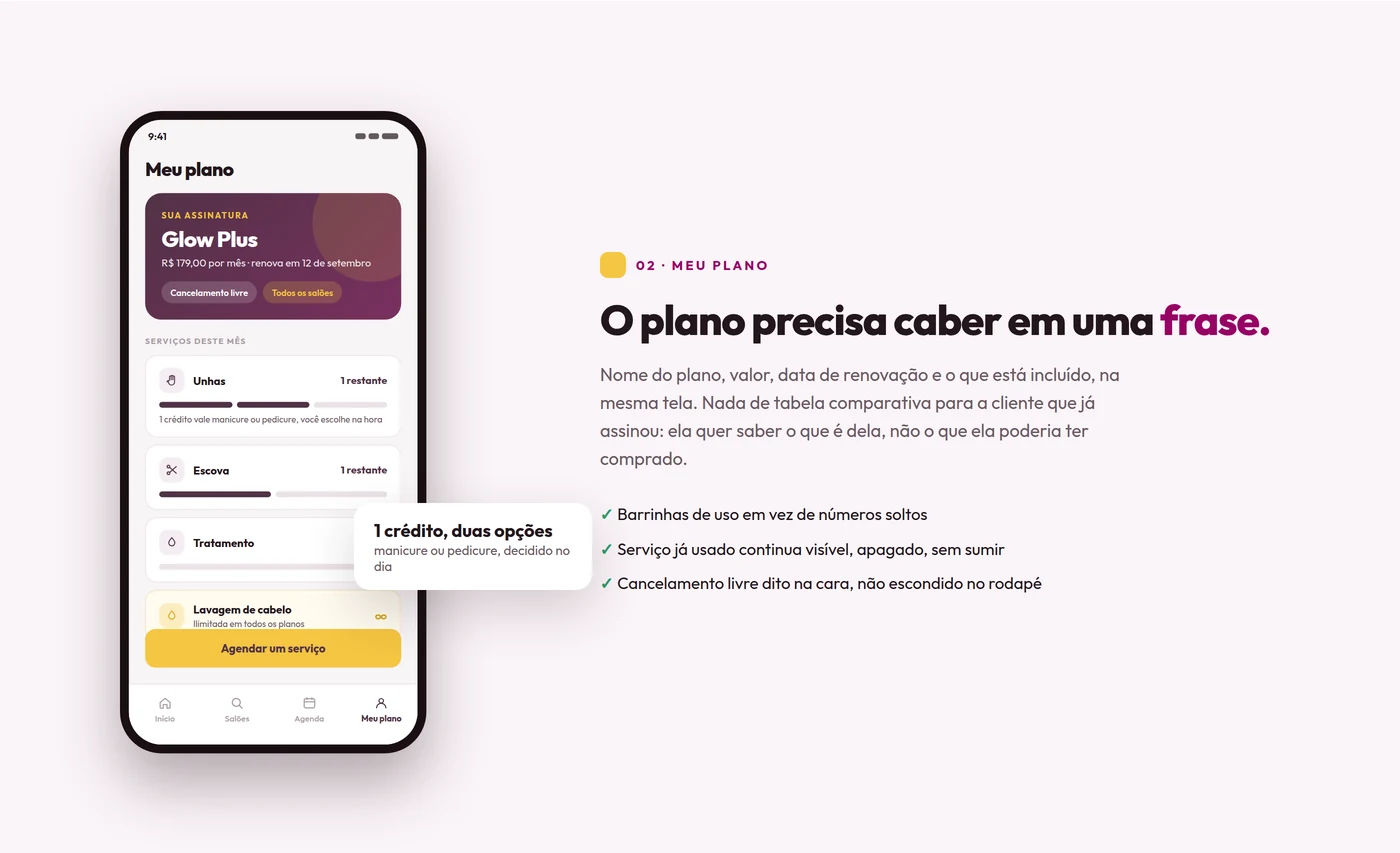
- A unified nail credit, so subscribers decide on booking day and not at sign-up
- Cancel anytime, with no fee and no minimum term, because contracts trap customers and generate bad reviews, not loyalty
- Price range for the men's line defined by a value perception survey with 26 respondents, delivered as a presentation for the board's decision
- Etapa 03
We put the service counter up front
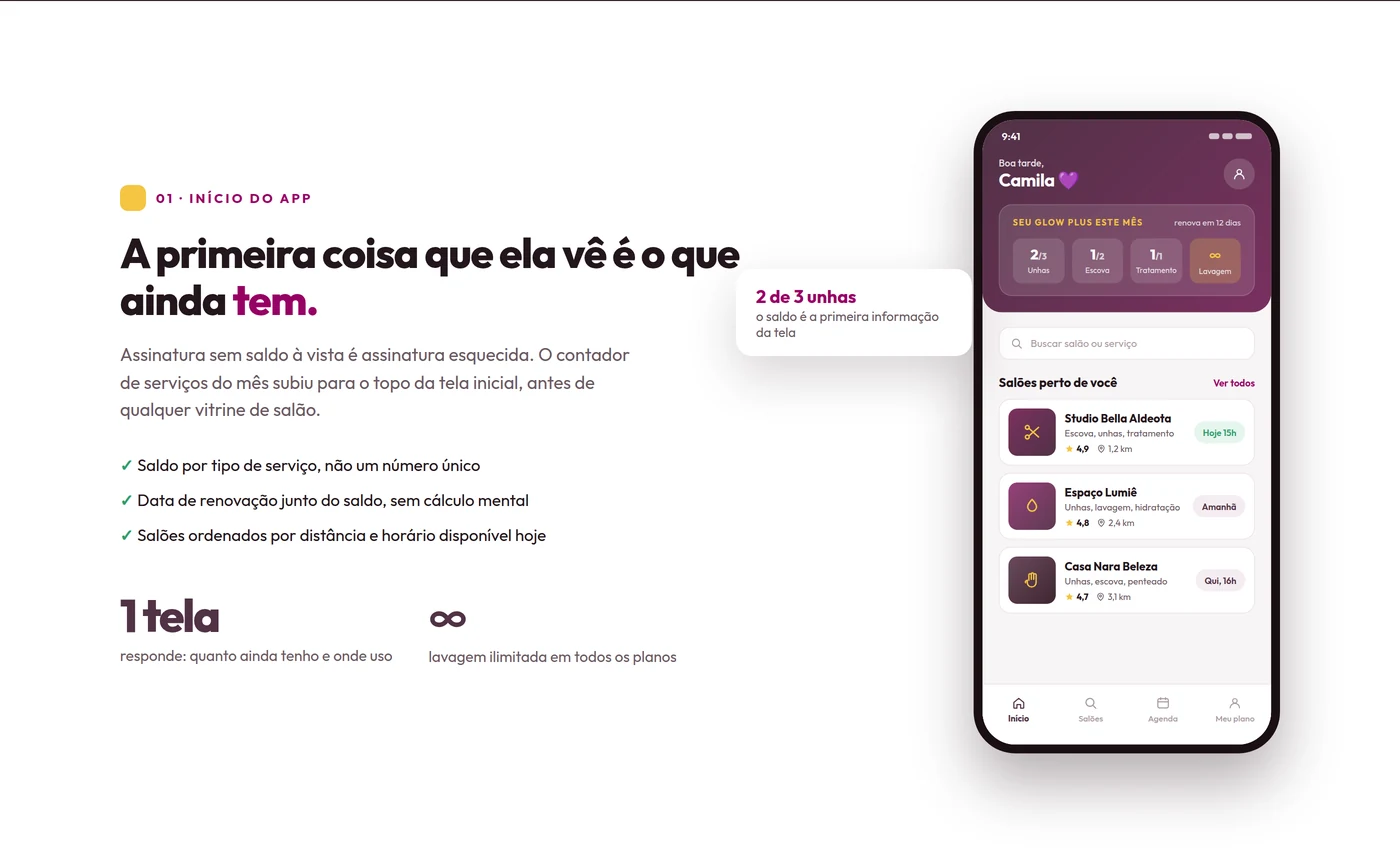
This was the simplest and most valuable change in the subscriber journey: showing, right on the home screen and the plan screen, how many services they have used and how many they have left in the month. A subscription without a counter is a forgotten subscription. Those who don't see their balance don't use it, and those who don't use it cancel.
- Etapa 04
We created a design system from scratch
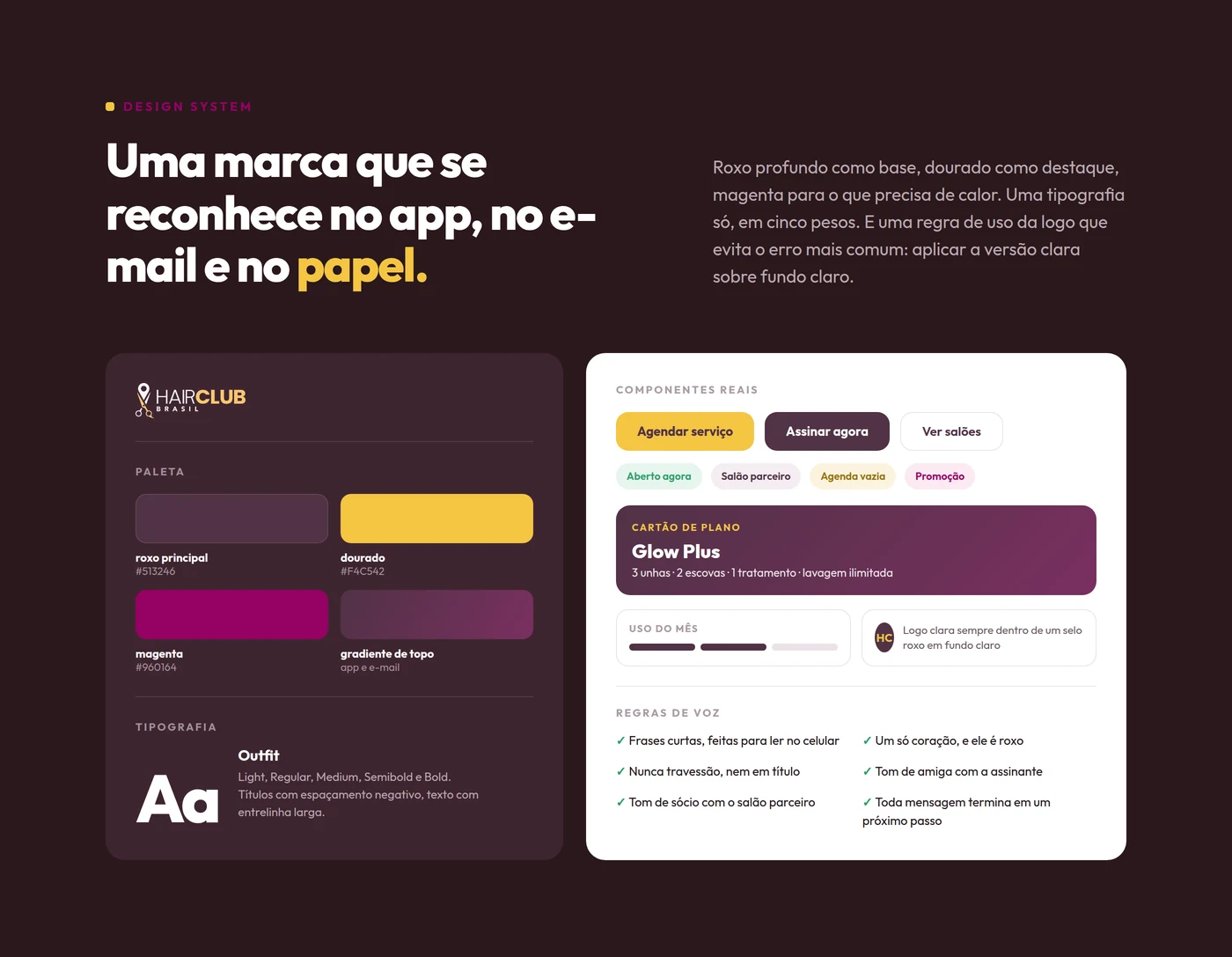
One palette, one typeface, one set of components and one brand usage rule. The same system now applies across the app, the internal dashboard, emails and printed documents. The gain isn't aesthetic, it's operational: every new piece comes out looking like the previous ones, even when someone else produces it.
- Etapa 05
We automated WhatsApp customer service
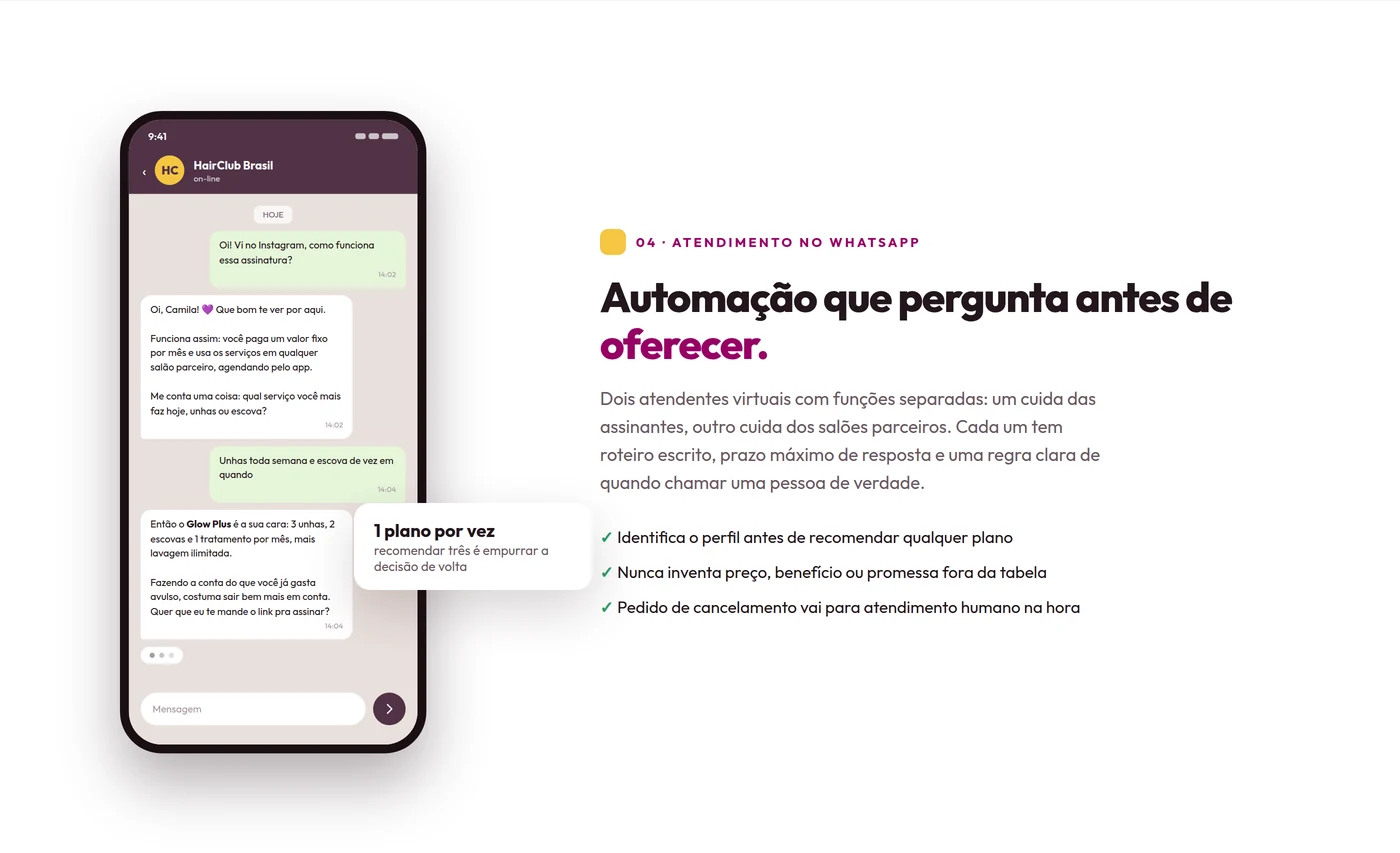
WhatsApp is where everything happens in Brazil, and it was where responses took the longest. We created two virtual assistants, each with its own personality and role: one takes care of subscribers, the other handles prospecting and support for partner salons. Each has a written script, a maximum response time and a clear rule for when to hand the conversation over to a real person. Automation without a human way out becomes a trap, and we don't do that.
- Etapa 06
We organized the partner materials
Salons now receive a complete visual guide to the platform, from first login to checking their payout, plus standardized messages for each moment of the relationship: invitation, training, schedule adjustments and reactivation. Training that depends on the memory of whoever explains it doesn't scale. Written down, it does.
The solution
Both journeys, the offer and the system that supports them
First, what is being promised on each side. Only then, the surface where that promise shows up.
The screens
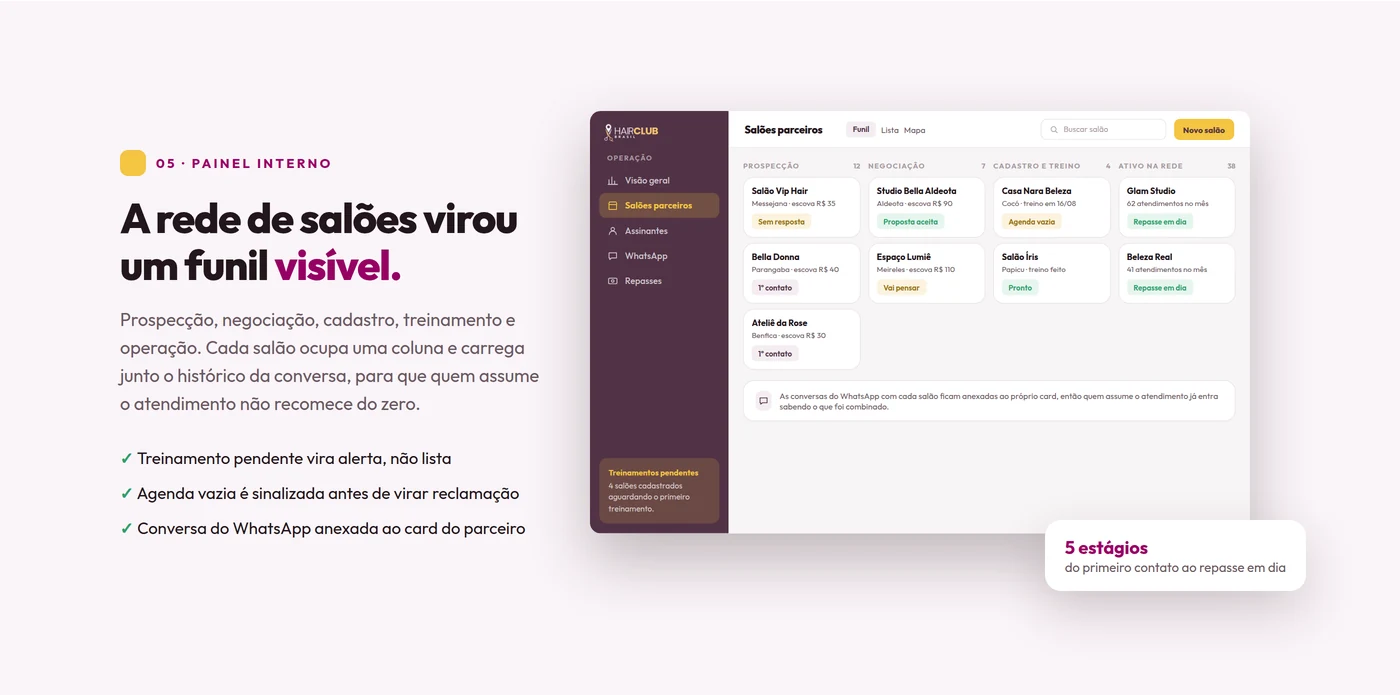
What the subscriber sees, what the salon sees and what the team sees
Five product surfaces, from the app's home screen to the dashboard used by the internal team.
The outcome
A promise that fits in one sentence, on both sides
Subscribers open the app and see, in order: how many services they have left this month, which salons are nearby and what they can book right now.
Partner salons join the platform with a guide that answers questions before they turn into support tickets, and they know exactly when the money comes in.
The brand became recognizable at every touchpoint, from the app to the welcome email.
And the internal team now runs everything from a single dashboard, with conversation history, the salon funnel and subscriber tracking in one place.
The result
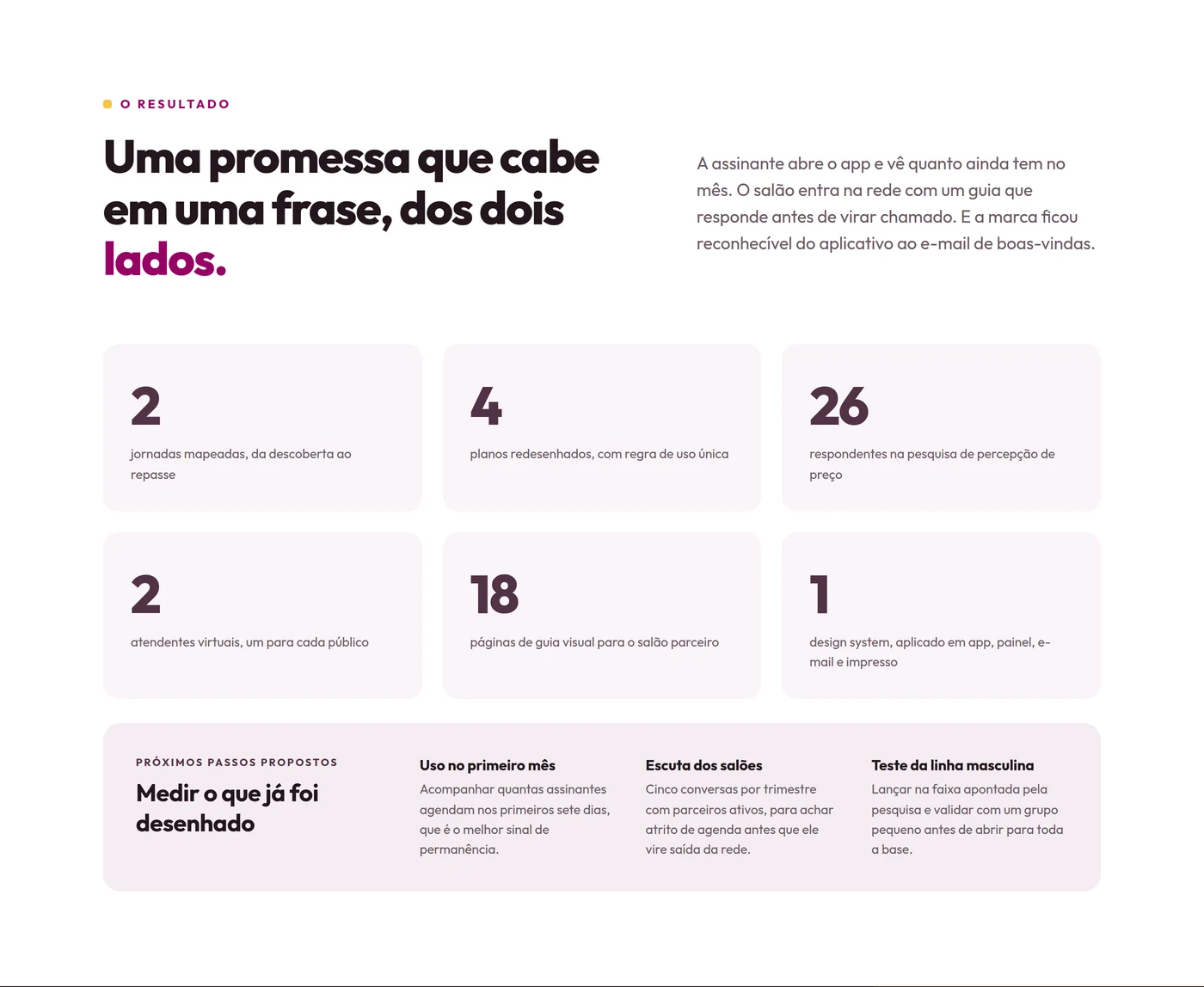
What was designed, in numbers
These numbers describe the scope of the work, not business performance. The usage metrics agreed with the client are being tracked.
- Journeys mapped
- 2Journeys mappedFrom discovery to payout, five moments on each side.
- Plans redesigned
- 4Plans redesignedWith a single usage rule and equal access to the whole network.
- Pricing survey respondents
- 26Pricing survey respondentsA value perception survey, with a recommended range instead of an opinion.
- Virtual assistants
- 2Virtual assistantsOne for subscribers, another for partner salons, each with its own script.
- Partner guide pages
- 18Partner guide pagesFrom first login to checking the payout.
- Design system
- 1Design systemApplied in the app, the dashboard, email and print.
Learnings
What carries over to other subscription products
- 01
Design shapes the promise, not just the screen
Redesigning the plans, simplifying a credit and putting a counter on the home screen changed the experience more than any visual refinement would have.
- 02
A subscription without a visible balance is a forgotten subscription
First-month usage is the best predictor of retention. Those who don't see their balance don't use it, and those who don't use it cancel.
- 03
Ask about price, don't copy it
Comparing with competitors tells you where the market is, not how much your product is worth to the people who will pay for it.
- 04
Automation needs a way out
A virtual assistant without a clear rule for when to bring in a person stops being a shortcut and becomes a trap.
Services applied
What was hired in this project
- Mapping the subscriber and partner salon journeys
- Value perception research to set pricing
- Restructuring the offer and subscription plans
- Designing the app and internal dashboard screens
- Creating the design system and brand usage rules
- WhatsApp customer service automation and partner training materials
- 01
Discovery Sprint
Research, analysis and opportunity mapping. We identify what is holding back growth and conversion before you invest in development.
- 02
Product Design
Wireframes, prototypes and design systems focused on conversion. Every screen is designed with intent: clear hierarchy, intuitive flow, zero noise.
- 03
Continuous Validation
Usability testing, metrics and evidence-based iteration. We don't deliver and disappear. We measure impact, learn and adjust.
Questions
Frequently asked questions about this work
What people usually ask before hiring a project like this one.
What is HairClub Brasil?
It's a beauty subscription platform. Members pay a fixed monthly fee and use services like manicures, blowouts, deep conditioning and hair washes at partner salons, booking through the app.
What did Heuristik do on the project?
End-to-end product design: mapping the subscriber and partner salon journeys, user research, restructuring the plans, creating the design system, designing the screens, automating WhatsApp customer service and producing partner training materials.
How does a partner salon join a subscription platform?
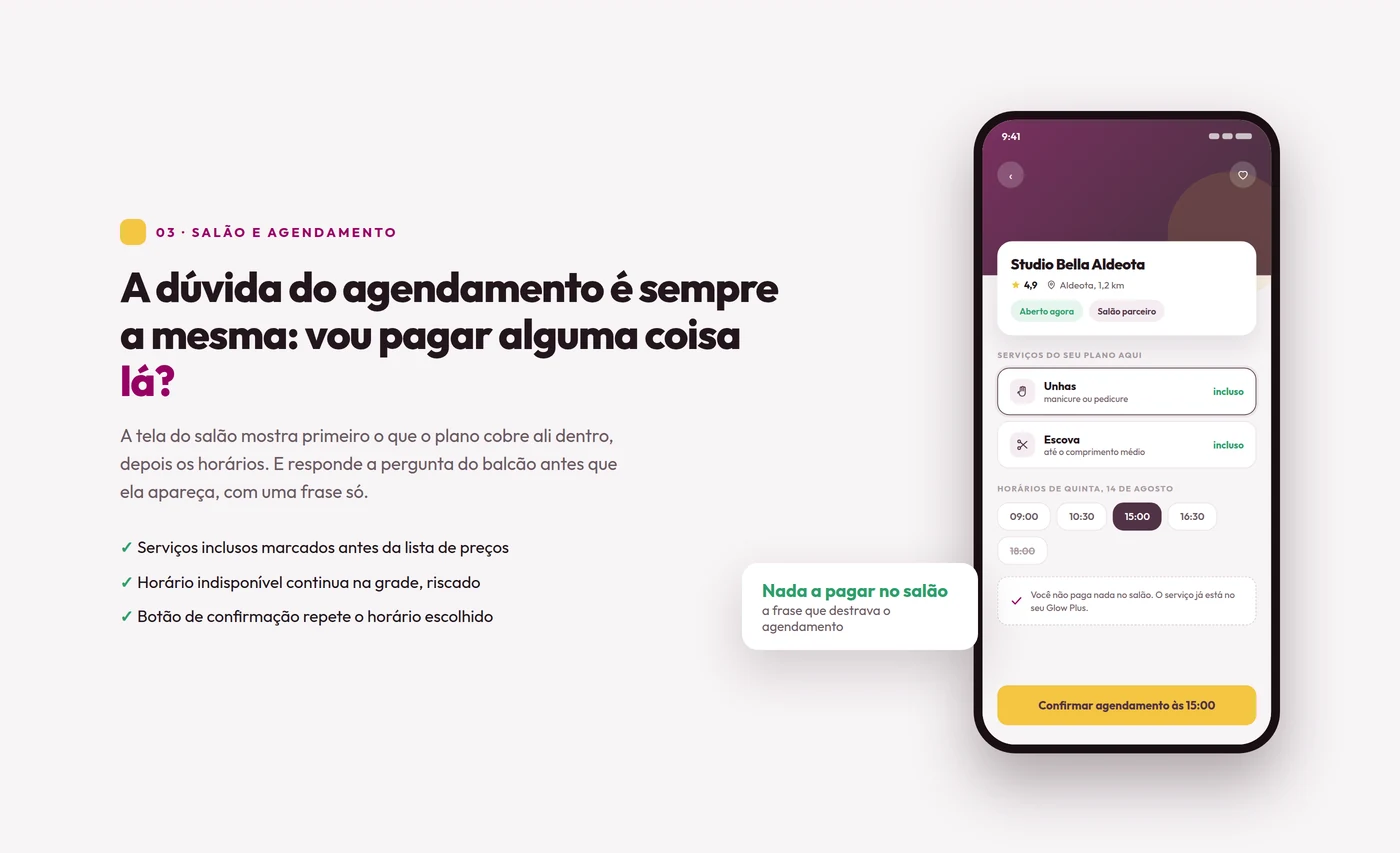
In HairClub's model, the salon registers on the platform, sets its available services and hours, serves subscribers who book through the app and receives its payout on a set date, without charging the customer at the counter.
How do you set the price of a subscription plan?
Price isn't set by comparing with competitors. On this project, we used a value perception survey with potential subscribers, which points to the range where the price stops seeming too cheap or too expensive.
Is a design system worth it for a small company?
Yes, and it's often worth even more. The smaller the team, the higher the cost of reinventing every piece from scratch.
Other case studies
View all- Small business management
Giro
Heuristik's own SaaS that tells a small business whether the month turned a profit. Sales are logged in the dashboard or in a WhatsApp message, and Giro does the math.
- Sports events
NovoTicket
A full review of the platform that sells race registrations across Brazil, from the runner's cart to the race organizer's dashboard.
- Conscious consumption
Vida Sem Teste
An open platform that answers in seconds a question that used to take half an hour of research: does this brand test on animals?
Next step
Have a subscription product your customers can't explain?
That's usually a design problem, not a marketing one. Heuristik addresses the offer before the interface, validates the decision with research and hands back a product that explains itself.